FAKE ART AND THE MYTH OF AUTHENTICATION
Sheila Sharpe
Why does art forgery succeed so successfully and so often? This question has haunted me through years of studying this fascinating subject and throughout the writing of my novel⎯Artist, Lover, Forger, Thief. As I am a psychologist, an artist, and a life-long mystery/thriller addict, it’s not surprising that I’ve been drawn to art forgery. Crime doesn’t pay, we’ve often been told, but art crime usually does. Art crimes generate six to eight crooked billion dollars a year. In the special case of art forgery, studies have reported 40 to 50 percent of all art in museums is fake.
Considering all the experts and scientific tests used to authenticate art, how are so many forgeries judged to be genuine masterpieces that sell for millions? A recent example is Leonardo da Vinci’s supposedly lost and rediscovered painting, Salvadore Mundi. How did this dubious “masterpiece” manage to fool Sotheby’s extensive authentication efforts and be sold to a Saudi prince for $450.3 million?
To answer these questions, I began to study the most famous art forgers. Soon I was led back in time to the greatest of them all⎯the Dutch artist and art dealer, Han van Meegeren. I confess to borrowing a piece of this forger’s true tale for my own forgery story, Artist, Lover, Forger, Thief. I concealed this theft quite well, having studied with the best. Picasso also gave his stamp of approval in his oft-quoted statement⎯Good artists copy, great artists steal.
Han van Meegeren’s remarkable tale goes back to WWII, where it was entwined with the intense rivalry between the voracious art collectors⎯Adolf Hitler and Hermann Goering. Hitler’s and Goering’s shared passion for art was a major driving force behind killing Jews, looting museums, and stealing from those who owned what they wanted.
Whatever or whoever stood in the way of the art they coveted was eliminated by any means necessary. While the two monsters were closely bonded, Goering being Hitler’s right hand and second-in-command, the reasons stoking their passion were quite different. Hitler’s goes back to his childhood dream of becoming a great painter. Unfortunately for the world, his artistic efforts were unappreciated. After twice failing the entrance exam to the Vienna Academy of Fine Arts, he raged against the corrupt art world and the Academy. It’s been speculated that Hitler’s antisemitism was fueled in part from his certainty that he and his art were unfairly rejected by the Academy’s Jewish judges. After rising to power, Hitler became an obsessive collector.
Goering, on the other hand, had no significant background in art. He was trained for an army career at which he excelled. His wife Carin was the one who promoted his enthusiasm for art. Under her tutelage, Goering came to love paintings and gazed at them fondly for hours, while Hitler’s main aim was to amass art for his and Germany’s glory. Over time Goering’s love of art was so insatiable and out of control, it became a pathological addiction along with his actual drug addiction, that turned him into a grossly overweight mountain of greed and violence. It is still thought that he accumulated the world’s largest art collection, and it would be, if intact, worth a whopping $2.9 billion today.
An intense rivalry developed between Goering and Hitler for the work of certain Dutch Golden Age painters. Johannes Vermeer was a top favorite of both, and generally one of the most revered painters of the time. The fact that Vermeer painted so few paintings, only 36 known, no doubt fueled the lust for one of his paintings. Near the beginning of WWII, Hitler, Goering, and the art world watched in awe as a series of five Vermeer paintings began to emerge from their supposed loss 300 years ago. It was a series of five religious paintings, not a subject known to be of interest to Vermeer, nor were they painted in his usual style.
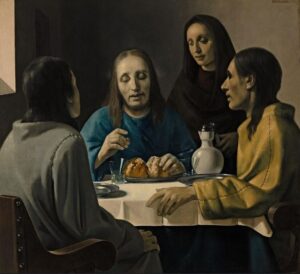
Fig. 1 The Supper at Emmaus
Han van Meegeren,
Museum Boijmans Van Beuningen, Rotterdam
The first of these “masterpieces” to appear was The Supper at Emmaus.. This painting caused a huge stir. The enraptured art world embraced it ecstatically as an authentic Vermeer. Abraham Bredius, the most authoritative Vermeer expert, exclaimed, “What a picture! What we have here…is the masterpiece of Johannes Vermeer…quite different from all his other paintings and yet every inch a Vermeer….”
Goering secretly competed with Hitler for this painting. Hitler wanted this masterpiece for his grand Führermuseum. His collection of great art in a magnificent museum was a central part of his fanatical mission To Make Germany Great Again. Goering withdrew, but in 1942 a certain successful Dutch art dealer offered him the last Vermeer in the series⎯Christ with the Adulteress. Goering paid the equivalent of $7 million dollars, the highest price ever paid for a painting at the time. The clever dealer responsible for the momentous sale to Goering became the richest man in Holland. He was the unsuspected art forger Han van Meegeren (1889-1947).
These newly found paintings passed all available technical tests done at the time, particularly the most important materials test. Oil paintings harden with age. If a rubbing with alcohol dissolves the paint, then the work is proved to be of recent origin and a forgery.
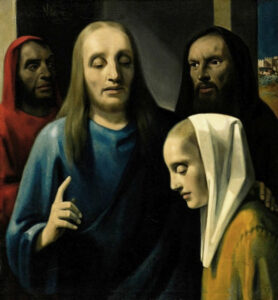
Christ with the Woman Taken in Adultery
Han van Meegeren, after Vermeer
1942
Authentication by eye is perhaps the most useful in this case. Comparing The Supper at Emmaus and Christ and the Adulteress with Vermeer’s long accepted masterpiece, The Concert, 1666, the artists distinguishing characteristics can be observed in this painting’s complex composition, the precisely defined setting, the beautifully rendered detail, the distinctive pearly light, and an entrancing aura of mystery.
The newly discovered paintings have none of the above characteristics of the master. The compositions are simple and unimaginative rendered with an amateurish painting style, and have an undefined, murky background. The characterizations of the people have no depth, the faces set in a one-note expression. The overall feeling tone of both is sentimental, and Vermeer was never sentimental in his previously known work.
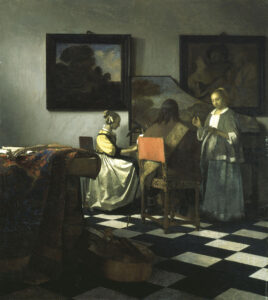
Johannes Vermeer, The Concert. Public domain, via Wikimedia Commons
These religious Vermeer paintings were eventually debunked, but the important question is why these works were so quickly and passionately accepted? One theory is that the “discovered” paintings filled a void. Art lovers and the art world longed for another Vermeer at that time. A more substantial theory is that these paintings fulfilled the German Volksgeist, the spirit of the times, perpetrated by Hitler. This national spirit portrays a simple, devout people who have faith in the future and faith in an all-knowing savior, a godlike leader like the Führer.
The brilliant forger Han van Meegeren with his homely, sentimental fakes, understood what kind of Vermeer paintings the Nazi and the people of the time could relate to and would embrace. He knew they would not feel a kinship with the real Vermeer’s pristine, structurally and psychologically complex style. With this crucial insight, the psychologically astute Van Meegeren engineered the most brilliant, dramatic, and deliciously wicked art scam in history. He gave the people exactly what they wanted⎯a simplistic, sentimental illusion of their lives.
The reasons Van Meegeren became an art forger are not the usual ones. From childhood, he was a talented artist devoted to becoming a painter. He won a gold medal while still a student, but after that he could not seem to develop his own cohesive style and was criticized for lacking “any sense of spiritual depth” or “an inner creative life.”
This failure led Van Meegeren to begin forging Vermeer and other famous Dutch artists, which he could do quite well and even successfully passed a couple off as originals. His main motive was not to make more money (he was already a financial success as a high-society portrait painter), rather he withdrew into forgery to salve his wounds and prove to the foolish art world that he was as great a painter as the old masters. Typically, those artists rejected by the official art world begin forging to make money and to exact revenge on the pompous, hated art establishment. But in the case of Van Meegeren⎯and my fictional forger Nick⎯identity problems, self-esteem issues, and arrested psychological development were also major factors.
As Jonathan Lopez (2009) pointed out, Van Meegeren’s “attraction to the imitative logic of forgery condemned [him] to a state of arrested development in which this kind of artistic role playing…became an end in itself.” (pp.78-79)
As a therapist, I could understand Van Meegeren’s psychological problems while also deploring his lack of ethics, but he was such an intelligent, resourceful, hardworking forger, I found myself admiring him. When a couple of his Vermeers were exposed as fakes because the oil paint dissolved when wiped with alcohol, Van Meegeren spent years developing a way to make the oil paint remain hard when tested. He found the solution by mixing paint with Bakelite, a forerunner to postwar thermoplastics. When dry, Bakelite made the oil paint impervious to an alcohol test. If only his technical skills and dedication could have been applied to developing his latent artistic talent.
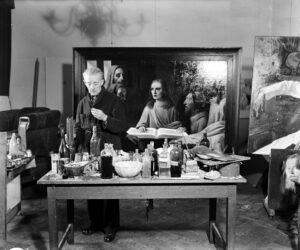
Van Meegeren painting Jesus Among the Doctors in 1945 https://www.essentialvermeer.com/misc/van_meegeren.html
Now for the unexpected twist. After the war, Van Meegeren’s sale of Christ and the Adulteress to Hermann Goering was discovered. The crooked dealer was then arrested as a collaborator with the enemy. To avoid a long, harsh sentence and possible death, Van Meegeren confessed to forging the Vermeer, saying he intended to deliberately fool and humiliate Goering.
No one believed his claim at first, because it seemed impossible that he had the ability to paint such a “masterpiece.” The forger then set about to prove he had the talent by painting another fake Vermeer in the same style as Goering’s Adulteress. Due to this successful demonstration, Van Meegeren’s trial lasted barely two months, resulting only in a minor forgery conviction. Not surprisingly, he entertained the court with his charm and clever remarks throughout the trial.
Now Van Meegeren was believed, and the devious scam artist became the idolized hero of the day. He was the most popular civilian in Holland, and the citizens demanded a statue be built in his honor. And here comes the final twist. The fact that Van Meegeren had been a notorious Nazi sympathizer came to light, but this well-known truth was completely overlooked. Astonishingly, he remained a hero.
This extraordinary story gives us a psychological explanation of why art forgery so often seduces and succeeds. Frequently, when people fall in love or lust with a painting, an artist, an ordinary person, or a politician, or a leader, they see what they want to see and will stick to their false views despite all contradictory evidence. This falling-for-the-fake syndrome, I can see clearly in my therapy work with couples and study of love relationships (The Ways We Love, 2000). There is a fascinating correlation between falling in love with a person and falling in love with a painting. The state of elation and the blindness to faults and flaws are similar, as this young man from my study group illustrates: “When I first met Lily,” he said, “I was so dazzled I could hardly speak. She was like my childhood dream of the beautiful princess.” In the development of love relationships, this state of idealization can last from only a few weeks to a lifetime.
Thomas Hoving, former Director of the Metropolitan Museum, studied and wrote extensively about the problem of art forgeries in museums and concluded with one simple observation⎯The world wants to be fooled. It seems we prefer to see a forgery⎯an idealized fake⎯rather than the truth of ourselves and others. The big question follows as to why we often prefer fakes and want to be fooled.
Perhaps the answers begin with a belief in wish fulfillment cultivated within us since early childhood. It is the magical belief that if we wish for something hard enough⎯pray, sacrifice, bargain, beat our chests⎯we should get it. Therefore, if you long to own a masterpiece by Van Gogh or Rembrandt, or Vermeer, surely you are entitled to have it. And if you are presented with a credible likeness of said masterpiece⎯even a questionable likeness⎯you are likely to see it as the real deal, especially if there’s competition for it (as between Goering and Hitler or at an auction). Once you commit to belief in the beguiling forgery, there are multiple reality-based reasons to cling for dear life to that belief.
When a painting is unmasked as a fake and the hard truth shatters the illusion, mass destruction can follow. The price paid by the buyer is often a monumental loss (as in the $450+ million recently paid for Leonardo’s Salvatore Mundi.) The reputations of the expert curators and authenticators can be destroyed (as in the case of Ambrose Bredius, authenticator of the fake Vermeers.) In addition, the dealer, the auction house, the gallery or museum that accepted or sold the fake are also discredited.
At the extreme, the intolerable humiliation of those fooled can result in the deadliest form of revenge. No expert forger tricked more of the art world mucky-mucks than the phenomenal British forger, Erick Hebborn. When he was brutally killed in Rome, many thought that one or more of those art underworld big shots he’d publicly humiliated had murdered him. Given the extreme forms of rage and humiliation experienced, a vicious murder does not seem surprising.
Lastly, I’ve come across two other interesting but contrasting reactions to forgeries. One is the authenticator or collector who refuses to believe a certain masterpiece is forged despite overwhelming evidence to the contrary. For example, Bredius suffered in isolated disgrace but never gave up his belief in the fake Vermeers. Then there are those owners of a cherished painting⎯like one couple I knew⎯who appeared unmoved to find out their treasured Chagall was a forgery. The reality didn’t matter, as they considered their painting just as beautiful and uplifting. This forged painting did no obvious harm. In fact, the fake Chagall seemed to bring as much joy as the original. In this case, and in a multitude of others, we are determined to see what we want to see. After all, as Voltaire wisely pointed out⎯Illusion is the first of all pleasures.
A final twist on the power of fake art to fool occurred when Donald Trump showed a Journalist his signed Renoir painting, titled Two Sisters, hanging on the wall of his Boeing 727. He claimed it to be “Worth $10 million.” Later, the painting was revealed to be a fake, the original one owned by The Art Institute of Chicago since 1933. In this case, can Trump’s claim be a result of his actual belief and that he was genuinely fooled, or was it a shameless lie that he used to impress and “fool” others? While in his forgery study, Thomas Hoving concludes, the world wants to be fooled, there are those who prefer to fool the world.
How I wanted to be fooled
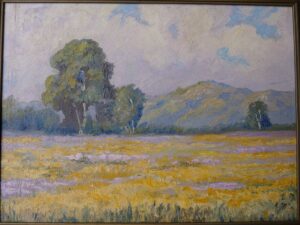 My own experience with trying to authenticate a painting further inspired me to write about the power of art forgery. My good friend, Joy, found an old oil painting in her deceased grandfather’s storage chest. It was a charming California landscape glowing through a century of grime. It was unsigned and we wondered who painted it and whether it could be valuable.
I brought the work to respected art conservator, Sondra Fleming, for evaluation and cleaning. The style and brushwork reminded her of the well-known California Impressionist, Maurice Braun. Studying the painting’s back, she said the age of the canvas appeared to be about a hundred years old, the right time Braun was living and painting in the San Diego area. She recommended I get the work authenticated by a Braun expert. My heart began racing. Was this a real Braun or a charming copy or a forgery? I was hooked. If it was a real Braun, how much would it be worth? Maybe if it was a very good forgery, it could pass as the original. I wondered if Joy would want to pursue an authentication.
While Sondra demonstrated how she would clean the painting and introduced me to the other techniques of conservation⎯many of which apply to art forging⎯I was falling in love with the charming picture. As Sondra cleaned a patch of the field, I could see Braun’s distinctive golden glow shining through, like the sun coming out. My skin tingled, and I gave it the title—Field of Gold. As the seconds ticked by, I became more and more convinced it was an extraordinary little painting and must be a real Braun, even though another part of my mind whispered, “Is it a bit too pretty?” Sondra murmured something about the simplistic composition, but then she seemed increasingly excited about its painterly virtues and jumped off her stool, compelled to call up the big time Braun collector she knew. He was prepared to drop everything and rushed to her studio.
When he arrived and saw the painting, he grabbed it off the easel and took it study in the light from the window. In less than a minute, he looked at us, his eyes shining and said in a rush, “There’s no doubt about it, this is an unknown, early Maurice Braun. A terrific find.” He looked at me, eyes wild and pleading. “How much do you want for it?”
I couldn’t give him an answer, but my friend Joy didn’t want to sell the picture. She came to believe her beloved grandfather had painted it, and she wanted to keep it as a treasured memory of him.
But Sondra, the big shot collector, and I, all knew the undeniable truth. Field of Gold, that glowing gem of a picture, was painted by none other than the preeminent California Impressionist Maurice Braun.
—
 Sheila Sharpe has been a therapist for more than forty years, specializing in treating trauma, couples, and artists. Being a detective of sorts to determine patients’ issues and their solutions like she does in The Ways We Love, along with her past history as an artist and fascination with art forgery, led to the creation of her new fiction book series, the Kate O’Dade Art Crime Novels, with Artist, Lover, Forger, Thief being the first book of the series, launching in April 2025.
Her roots in art are long and deep. A painter and storyteller since early childhood, Sharpe earned an undergraduate degree in painting and sculpture, as well as a degree in English Literature, from Connecticut College. Next, she earned an MFA in painting and film criticism from the University of California – San Diego, where she also taught both of those subjects.
Following her stint at UCSD, Sharpe used these creative and artistic skills working as an art teacher and social worker, before earning a PhD in clinical psychology.As a therapist and struggling artist, Sharpe began investigating the dark side of the art world, especially art forgery. This research, plus Sharpe’s therapy with creative people, led her to uncover why certain talented but traumatized artists became brilliant forgers. This research serves as the basis for the Kate O’Dade Art Crime Novels book series.
Sharpe lives in southern California, with her husband, Michael, a professor emeritus at UCSD.
Artist, Lover, Forger, Thief
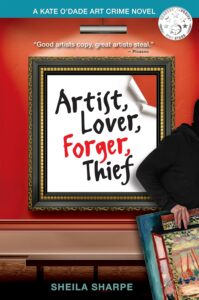 Artist, Lover, Forger, Thief is a riveting, wildly entertaining, complex, and adrenaline-fueled art crime novel that is as intriguing as it is satisfying. Nick McCoy wants out of the art forgery business but not until he exacts revenge on the man who murdered his family years ago. Kate O’Dade, McCoy’s former therapist, comes to him for help after mysteriously receiving a painting of Matisse’s Open Window from an unknown benefactor. This seemingly innocent meeting to determine its authenticity sets off a chain of events that will take McCoy, O’Dade, Cromwell and his new team of investigators from San Diego to England, and from art forgery to murder.
Rarely do you find such complex characters, intricate plot, compelling subject, and cunning psychological jousting woven throughout such a memorable story like Sharpe does in Artist, Lover, Forger, Thief.
BUY HERE
Category: On Writing
Subscribe
If you enjoyed this article, subscribe to receive more just like it.