Female Power and Agency in Crime Fiction by Emma Styles
by Emma Styles
 Now that my second crime novel The Shark is out in the world and reviews have started to come in, I’ve been reflecting on the recent explosion of women writing crime fiction – turning to crime from romance, literary or children’s fiction, or setting out as debuts to bring a fresh approach to an enduringly popular genre. These authors are changing the narrative by writing powerful, nuanced, flawed female characters driving a multitude of plots from dark serial killer thrillers to historical cosy mysteries.
I was asked recently at a book event why I choose to write from the point of view of young women. At the time I answered that it’s what I naturally do – write young female characters who are not powerful in their lives and have them turn the tables in some way – but on reflection there’s a lot more to it. So why do we love to read and write these characters? What’s happening now in the crime genre, and where might it go next?
Crime fiction remains popular because in most instances it gives us an illusion of control in a world where, much of the time, we have little control at all. In the majority of crime novels, the status quo is disrupted and the story twists and turns before order is restored. There’s a crime, an investigation and a solution, followed by some form of resolution and justice, whether natural or delivered by the criminal justice system. The structure may not be linear, the plot may involve multiple timelines and points of view, and there are always exceptions – true noir where chaos triumphs at the end, the killers who go undetected and walk away – but for the most part, readers of crime novels can count on a resolution that’s not always available in real life.
World Health Organisation data published in 2021 estimated around 1 in 3 women globally have experienced physical and/or sexual partner violence, or non-partner sexual violence in their lifetime. According to the 2025 Femicide Report from UN Women and the United Nations Office on Drugs and Crime (UNODC), 50,000 women and girls worldwide were killed by intimate partners or family members in 2024 – one every 10 minutes. In the world we now live in, with the rise of the right, incels, post-truth, post-Roe v Wade, and Artificial Intelligence – The New Age of Sexism as Laura Bates entreats us – is it any wonder that those of us writing crime fiction want to give power and agency to fictional women whose real-life counterparts do not always have access to it?
Growing up in the seventies and eighties, I experienced the everyday sexism and misogyny characteristic of the time. But the message I received concurrently, loud and clear from both my parents, was that I could do anything I wanted with my life if I put my mind to it. My childhood career aspirations ran from Olympic equestrian to commercial pilot and although I didn’t choose either as a career path, it’s clear I took on the message. The intersection of these two experiences is a big influence on the kinds of characters I write now.
During the lockdowns of 2020 when I was writing the first draft of my debut, No Country for Girls, I frequently felt I was writing something far-fetched. I questioned whether readers would suspend their disbelief as I wrote this Thelma & Louise-style road trip. I wondered about the bad dudes my girl characters met on the road, including more than one corrupt police officer. Was I taking some aspects that bit too far? Then in 2021 Sarah Everard was abducted and murdered by a serving police officer while walking home on a London street, and I wondered instead if I was going far enough.
We’ve all read stories about the dead girl, the doomed femme fatale, the love interest only present in a supporting role, but women authors have been writing female characters in crime novels – from detectives to perpetrators – with evolving agency and complexity since the 1800s.
Many of these authors have become household names and catapulted their iconic characters into the spotlight, or is it the other way around? Marple, Vera, V.I. Warshawski, Jane Tennison, and Scarpetta are all stars of multiple screen adaptations as well as novels. These authors and characters do not stand still but continue to push boundaries and evolve. To celebrate the anniversary of Agatha Christie’s death fifty years ago, Miss Marple will be reinvented by Lucy Foley in Murder at the Grand Alpine Hotel. Val McDermid brought us a brand-new series character in Allie Burns and as of 2026 has sold over 19 million books. Gillian Flynn’s Amy Dunne took the femme fatale to new and unflinching extremes, while Paula Hawkins wrote The Girl on the Train in a state of ‘dread verging on panic’ that helped her nail the story that by 2021 had sold 23 million copies worldwide.
The success of these authors and their characters has paved the way for many more flawed, complex, ambitious portrayals of women who constantly subvert expectations. Oyinkan Braithwaite’s serial killer Ayoola broke the mould when her debut My Sister, the Serial Killer blazed onto the scene. Naomi Alderman’s The Power gave us ‘The Hunger Games meets The Handmaid’s Tale’ and a trio of female characters who take their new-found physical power and run amok with it. In both Blood Sugar by Sascha Rothchild and Murder By Natural Causes by Helen Erichsen, the protagonists dispatch victims with some of the most ingenious methods I’ve encountered on the page.
These are women who put the ‘a’ in agency, stopping at nothing to get what they want. Women with insatiable appetites, like Hazeline, the inscrutable billionaire with scary tastes in Callie Kazumi’s second novel Greedy. Women with unusual methods of detecting, like Sara Gran’s Claire DeWitt or Jesse Q. Sutanto’s Vera Wong. Then there are those with creative takes on justice, like Rebecca Philipson’s DI Samantha Hansen in her debut How to Get Away With Murder, a serial killer thriller that propels the reader to a hugely satisfying final reveal.
Other stories like Angie Faye Martin’s debut Melaleuca, Tracey Lien’s All That’s Left Unsaid, Long Bright River by Liz Moore and All Us Sinners by Katy Massey, concentrate on the impact of violent crime on the communities these characters belong to as much as the crimes themselves.
Far from the murder victims and femmes fatales of early noir and hard-boiled crime, these characters and their authors have taken Miss Marple and her contemporaries and run with them. Whether we’re looking for escapism, realism, to learn something about society, or all of the above, these are relatable, all too human characters we want to spend time with whatever their brand of criminality or justice. I can’t wait to see what ambitious female characters the crime genre gives us next, and I look forward to writing more of them myself.
—
Emma Styles writes Australian crime fiction about young women taking on the patriarchy. Her debut novel, No Country for Girls, won the Wilbur Smith Adventure Writing Prize and the Little, Brown UEA Crime Fiction Award. It was a New Blood selection at Theakston’s Crime in Harrogate and was shortlisted for the CWA New Blood Dagger, the Davitt Award for Best Adult Crime Novel and the ACWA Ned Kelly Award for Best Debut Crime Fiction. The Shark is her second standalone thriller.
Emma grew up near the beach on Whadjuk Noongar Country in Perth, Western Australia and now lives on the south coast of the UK. She’s worked as a veterinarian in country and coastal Australia and the UK, and spent her teens and twenties learning to ski, snowboard, ride horses and motorcycles, and fly small aeroplanes. She loves wild swimming, is less afraid of great white sharks than she should be, and hopeless at surfing.
THE SHARK
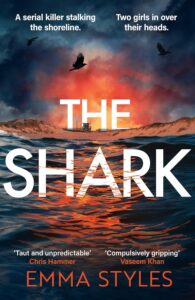 ‘Totally original. A taut and unpredictable thriller’ CHRIS HAMMER
‘A compulsively gripping twist . . . Terrific’ VASEEM KHAN
‘A propulsive and utterly compelling story’ PETER PAPATHANASIOU
Every monster has a weakness.
At the height of Australian summer, a serial killer known as The Shark stalks a coastal suburb, hunting young female swimmers.
Afraid and furious at the failure of the police to protect them, two women fight back. Raych is grieving someone she’d have died to save, while Carmen hides her own disturbing connection to the murders.
In desperation, they form an uneasy alliance. And when another girl vanishes, they take matters into their own hands – by kidnapping the prime suspect. But as their interrogation spirals, horrifying truths surface on both sides of the table.
The clock is ticking to save the missing girl. And in their quest for justice, Raych and Carmen must face the darkest question of all: have they caught a monster – or become one?
The Shark is a propulsive psychological thriller about fear, vengeance and the thin line between predator and victim.
The Shark by Emma Styles (Sphere, £25) is available from all good bookshops. https://www.hachette.co.uk/titles/emma-styles/the-shark/9781408722435/
Category: On Writing
Subscribe
If you enjoyed this article, subscribe to receive more just like it.