Finding My Voice By Rikki West
Finding My Voice By Rikki West
“You slip the voice back and forth from adult narrator to the child perspective,” my first editor pointed out after reading a few chapters of The Empty Bowl. She showed me how the use of “Daddy” instead of “my father” could change the entire tone of a sentence. At first I struggled to see the distinction, but I learned.
When I started this memoir, I knew I would need help. Through social media, I found several writers and we formed a working group. We produced a chapter every week or two, emailed our submissions to one another, made suggestions and edits, rewrote and met to talk in zoom.
I dug deep, telling my story as vigorously and honestly as I could. Most weeks I submitted what I thought was terrific work. I pulled poignant and powerful scenes from my life which felt spot on. But my stalwart friends gave me honest feedback: too much passive voice, repetitive sentence structure, verb tenses, adverbs, missing backstory. I knew they were right. Over the course of the next two years, I chipped away at these sins.
Most egregious were the moments when I tried to describe a particular inner experience or scientific concept.
I would suddenly sound like an imitation Neil deGrasse Tyson. Or worse, a metaphysical you-tube guru. I could veer from the here-and-now storyteller into someone in a state of mystic rapture intent on gaining converts to my vision. Insights are okay, but the reader does not want to hear speculation. It’s available on a scale from nutty to transcendent everywhere on the internet.
It took rounds of feedback about voice before I could get it under control. Two hundred years ago, novelists like Melville and Hugo could get away with shifts in voice, but not me and not for modern readers.
But after today’s zoom, I let my discouraged pen fall onto a textured white sheet in my workbook. An elevator had dropped from my throat to my belly—you know the feeling—leaving me hollow and achy. My friends had nailed me again. I had a voice issue and no idea how to fix it.
At this point in my narrative, I needed to communicate the impact on our contemporary worldview of some recent developments in quantum science. I needed to explain how tiny bits of matter observed in countless experiments defy certain laws of physics. But every time I tried, the words came out like a lecture.
“Frankly, I barely read this part. It’s boring, and what is it doing in the middle of the story?” Evelyn had asked at our today’s writers zoom. The others agreed.
Voice. I had subtly switched from story-teller to physics lecturer, losing connection with my reader and breaking the container of the scene.
I got up from my desk and wandered into the living room where my wife, Jill, was tinkering with some contraption. After I gave out a few despondent sighs, she looked up.
“How’d the meeting go?”
“They hated it.”
“Uh-oh.” She just looked at me.
I sat down.
“You’ll think of something. You always do.”
She was right.
I dropped the problem down into the inner creative center that had pushed me to do all this writing in the first place. I gritted my teeth. I developed headaches. I cried.
A few days later, I remembered that my step-father and I used to debate this stuff all the time. He did not believe the conclusions one had to draw from quantum mechanics, so our discussions were lively. I reproduced one of these to introduce the ideas to my narrative. The following week, the chapter got the blessing of my writers’ team.
I learned through trial and error. In creative nonfiction, I had to show, not tell. I couldn’t lecture you about science but I could share my conversation about the thrill I felt at my discoveries. I might have a nifty metaphysical concept to propose, but instead I must write what happened, how it affected me, what changed.
After more than a hundred group sessions and endless rewriting, red penning, and paper tossing, I had a beautiful, shiny manuscript filled with truths.
Then I got a story editor.
Apart from finding numerous factual errors and instances of twisted writing, my editor quickly noticed that I failed in what is probably one of the top five writing mandates: start chapters in the middle of the action.
Week by week, chapters came back slashed with metaphorical red ink. Move this to there; start with this; find the action; take out; rework; check timeline. Open in scene. Reorder.
I had only a few weeks left before submitting to the publisher. In a mad dash of rewrites, I produced dozens of fresh pages. No time for review with my writer friends.
The title? We probably came up with fifty or sixty titles before we nailed it. The Empty Bowl: Pursuing truth in a messy world.
Then, after surviving six months of marketing and advertising efforts, I swore I would never pick up another pen.
And yet, I have already outlined the next creation! I just need to find the right voice.
—
–Rikki West (www.rikkiwest.com) is the author of two memoirs, Rootlines and The Empty Bowl (https://www.simonandschuster.com/authors/Rikki-West/222274417.
THE EMPTY BOWL
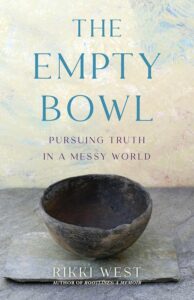 Perfect for readers who seek understanding of how they fit into the universe, Rikki West’s vibrant memoir follows her journey of confronting hidden assumptions and childhood trauma on the way to finding her life’s vibrant, living truth.
At seven, Rikki West begs a mysterious God for help, praying that her drunk father won’t harm their family and that he won’t be sent to hell. But when nothing seems to happen, she worries: Is anyone up there really listening?
This question triggers a lifelong search for the great, loving being she imagines her prayers might reach. Delving into Catholicism, psychedelics, transcendental meditation, yoga, AA and Buddhist chanting, she explores every available path. She studies genetic science at UC Berkeley and humanities at San Francisco State, combing through the knowledge they offer for answers to the big questions.
A single lesbian mom, Rikki soars in her Silicon Valley career until the dot-com bust leads to the loss of opportunities. At age 56, she finds herself barely employable. Yet, with bills to pay and the drive to earn her own way, Rikki seeks whatever odd jobs she can patch together, from barista and gardener to deck builder, proposal writer, newspaper deliverer, and substitute teacher.
Along the way, she keeps up her questioning of the universe. But it is only when she throws overboard all her notions of God and truth that something unexpected and wonderful blossoms in her. At the age of seventy-one, Rikki recognizes her answer—in the most surprising place.
The place called “I.”
BUY HERE
Category: Contemporary Women Writers
Subscribe
If you enjoyed this article, subscribe to receive more just like it.