Fresh Air and Possibility: On Poetry, Verse Novels, and Writing Books Kids Love to Read by Ona Gritz
One gray afternoon when I was in 7th grade, a tall man with floppy hair loped into the room at the start of our English class with a hardcover the size of a phone book under his arm. Our sub for the day, he leaned against the teacher’s desk and announced, “I’m just going to read you some poems.”
Around me, tongues clicked, eyes rolled, my best friend laid her head on her arms as though the idea of hearing poems for the next forty minutes was a weight too heavy to bear. I got the message—poetry was Not Cool—but I didn’t understand it. Would they all really rather fill in grammar worksheets than be read to?
The sub read us “Richard Cory.” He read “Nothing Gold Can Stay.” He read “Fog.” As I took in the images, the rhythm, the flashes of intimacy and wisdom, each poem felt like a window. Like access to fresh air and possibility. If I tried to look bored to fit in with my peers, I quickly gave up the ruse.
I was already a reader then and had recently decided I wanted to be a writer when I grew up. My favorite authors were Judy Blume and Norma Klein and I hoped to do what they did—write books for kids like me who felt muddled and outside of things and found clarity and comfort in entering someone else’s world. The problem was that I never finished the stories I wrote. I liked thinking up characters and giving voice to their inner lives. I liked placing words next to each other in ways that pleased me. But when I got to where something had to happen to my characters, I lost interest. I wasn’t a storyteller. Not yet. What I just might be, I thought as I sat among my fidgeting classmates hearing Robinson and Frost and Sandburg for the first time, was a poet.
In Ada Limón’s Against Breaking, an expansion of her closing lecture as poet laureate of the United States, she writes “…if we are lucky enough to live a life in poetry, we are never alone.” I’ve found this to be true in many ways. As Limón goes on to say, “We are never alone because everyone who has ever written is with us.” I’ll add that our poems themselves are good company. They illuminate our feelings, show us what we didn’t know we knew, invite us to listen and observe. Also, a life in poetry means a life among poets. I’ve met my closest friends at poetry readings and workshops and have had the great fortune to study with the poets I most admire. Having married a poet, I live in a house where, at any moment, one of us might interrupt a meal, chore, or unrelated conversation to say, “I read an incredible poem today. You need to hear this.”
I’m grateful to that sub whose name has long been lost to me, and to the girl I was who recognized how well a life in poetry would suit me. But what she couldn’t yet know was that honing my poetry skills helped me fulfill my earlier dream of writing books for kids like her.
Like poetry, kidlit calls for concision, lucidity, and emotional authenticity. An ear for the music in poems can translate to an ear for dialogue. And, through its focus and precision, poetry reminds us that where we put our attention moment to moment makes us who we are. Knowing this is key to creating characters who feel human.
These days, what I write, read, and can’t get enough of are middle grade and young adult verse novels. Stories built poem by poem, which is to say moment by moment.
Verse novels aren’t a new phenomenon. There’s Gilgamesh, The Iliad, The Odyssey, books as old as literature itself. But for nearly thirty years now, thanks to Karen Hesse’s groundbreaking Out of the Dust, kids have claimed the genre as their own.
Maybe, all those years ago, what my classmates balked at wasn’t so much the idea of poetry, likely vague to them at best, but the thick tome that housed the poems. Maybe they expected to hear something as long and archaic as The Odyssey. But verse novels written for today’s teens and tweens are the opposite of intimidating. Crack one open and you’ll often see more white space than ink, making them the perfect gateway for hesitant readers. A sixty-word poem can set a scene, introduce a character, and convey a layering of feelings. That one poem, read quickly and understood easily, leads to the turning of the page, the reading of another and another, until the most tentative reader has felt the satisfaction of finishing a book.
I used to love
the library
clock tower.
How it watched over
Greenwich Village.
A sun that never
hurt our eyes.
Every hour, it sang
in its deep voice.
When I was three,
I liked to count
those bong, bong, bongs.
Now, I’m thirteen,
and those bongs
just annoy me.
Just remind me
time runs my life.
Those fifty-seven words make up the first page of If You Find This Letter, my new middle grade novel about friendship, family, disability, and time-traveling letters. Welcome, I hope they say. Join this journey. Let these little paving stones called poems lead the way.
Ona Gritz is the author of three verse novels: Take a Sad Song, a Kirkus Reviews Best YA title of 2024, The Space You Left Behind, a CBC Disability Pride Month Recommended Read, and If You Find This Letter, a CBC Anticipated Best Seller. Her 2024 memoir Everywhere I Look won the Clara Johnson Award in Women’s Literature, the Readers’ Choice Gold Award, the Pencraft Best Book Award, and was named a Kirkus Reviews “Indie Worth Discovering” and the StoryTrade Nonfiction Book of the Year.
IF YOU FIND THIS LETTER, Ona Gritz
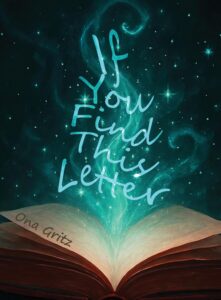 Few things feel worse than being left behind by your best friends, but that’s what’s happening to thirteen-year-old Dani. She has far less freedom than they do when it comes to roaming their New York City neighborhood, thanks to her over-protective mom. Dani knows her mom has her reasons–including having lost her leg in an accident when she was Dani’s age. But it still doesn’t seem fair.
Following an especially painful falling out with her friends, Dani finds herself wishing she could change her mom’s past, making life easier for both of them. Soon after, she wanders into an oddity shop where she discovers a letter in an old book. It’s from a girl named Mimi who is seeking a friend. The two begin leaving daily letters for each other in the book, growing close and connecting over losing their best friends. Some of Mimi’s sayings and experiences are very dated, but Dani manages to explain this away–until she can’t ignore the strange coincidences and odd references. Who is her mysterious new friend? Do her letters hold the clues Dani needs to heal her broken relationships, especially with her own mother? Or is she too late?
BUY HERE
Category: On Writing
Subscribe
If you enjoyed this article, subscribe to receive more just like it.