Let It Breathe: Unleashing the Power of Setting
By Kimberly Behre Kenna
 Can a house loom like a monster and still show up as the most tender thing in a story?
In the opening scene of this middle-grade novel, thirteen-year-old Lola arrives at her uncle’s home:
“…as soon as we turn into the driveway and I catch a glimpse of the stone roof nearly touching the top of the tallest tree, it all comes back. Uncle Milo’s house is more of a mansion. It rises up at you like King Kong on a mission, with a creepy factor so high you want to turn around and go home. But soon as you’re at the front steps, the place becomes insanely un-ferocious. Lopsided stones in bulging walls. Turret-type towers droopy as sandcastles in the way of a rising tide. A few windows, too tiny to make a difference.”
The monster transforms! Still bizarre, yes, but now it’s also vulnerable. This shift is where the story begins to unfold.
In my books, setting rarely functions as background scenery. Instead, it behaves more like a living system that reacts to the characters moving through it. As the place changes, the characters change with it. Over time, I’ve realized this has become a pattern across all of my stories.
In my middle-grade novel, Lola Gillette and the Summer of Second Chances, Lola arrives at her uncle’s dilapidated mansion still grieving the loss of her twin sister. As she explores the house and grounds, she begins to see not only the decay but the potential.
Gradually, she starts repairing small bits of it—clearing clutter, dusting corners, coaxing life back into neglected gardens and wooded trails. Each small act alters the atmosphere of the house. And with every change, Lola herself shifts from someone overwhelmed by grief into someone capable of shaping the world around her. The house doesn’t solve her problems, but it sparks her agency.
Uncle Milo resists the idea of upkeep, clinging to the past in his own quiet way. Lola’s acts of restoration challenge his resistance. As the two push and pull, the house becomes a mirror for their conflict and their healing. The story grows from the ongoing exchange between a shifting environment and the people living inside it.
Through these details, readers connect to settings, and they understand how the stakes of the story deepen. The loss of that setting matters, and readers care about protecting it alongside the characters.
Settings in my stories often begin as real places that I love and know well. Each of my middle-grade novels is inspired by a location here in Connecticut: a Long Island Sound salt marsh, a historic library, and a stone castle perched above the Connecticut River. When I begin to write about places like these, I don’t try to reproduce them exactly.
I wander through the real landscapes and look beyond their beauty or uniqueness and ask, “What if…?” What if the salt marsh where Artemis, a girl who finds peace there, suddenly withered away? Would something inside her disappear too? Then, I go deeper and look for emotional truths the landscapes might hold. A displaced bird in that marsh might embody quiet yet determined resilience.
A library might represent brave wanderings through unfamiliar worlds. A castle might suggest fear of past secrets resurfacing. This is also where themes may emerge. In my books, the theme of silencing is prevalent: unspoken grief, unacknowledged trauma, abandoning the past. Once that emotional, thematic core becomes evident, the setting can begin to shape the character’s journey and vice versa.
The same tension drives the story of Jett Jamison who stumbles upon a mystery involving a missing book at her local library, a place that has always been her sanctuary. Jett knows every corner of the building, from the granite staircases to the quiet study nooks and the smell of the stacks. But when the disappearance of a highly recommended book exposes deep tensions within the community, the library no longer feels safe.
Something in the emotional climate has shifted. Now something in Jett Jamison will shift, too. Disruptions like this often drive the most important choices in a story. The setting doesn’t solve their problems, but it gives the characters the opportunity to confront them. As the girls repair, reclaim, and protect the places they love, their developing competence feeds their voices. Through the action of restoring something tangible, they gain the power to speak up for themselves and ultimately for others.
By the end of Jett Jamison’s story, a group of kids has transformed a neglected lot behind an abandoned factory into a thriving community garden. A long brick wall that once separated the neighborhood from the overgrown space now borders the garden. The wall has become a graffiti mural where anyone can leave words or drawings that hold meaning for them. In one corner, Jett writes a line from Ralph Waldo Emerson: “Even in the mud and scum of things, something always, always sings.” The wall once kept people out. Now it carries their voices.
With so many of our real-life landscapes, both physical and cultural, under threat, stories can remind us why they matter and provide hope by illustrating the only constant truth – that things always change. We need to remember the places where we felt safe and capable as children, places where we found refuge and learned to listen. When we write those places into our stories, they don’t need to remain static. They mustn’t. Because the most powerful settings are the ones that breathe and set our characters free.
—
KIMBERLY BEHRE KENNA: After teaching fifth grade for many years, Kimberly earned an MA in Creative Writing from Wilkes University. Her children’s books have received recognition from the Nautilus Book Award, the Eric Hoffer Award, the Foreword INDIES Award, and the Green Earth Book Award. Kimberly has been a panelist and presenter at SCBWI events and workshops, a featured speaker at bookstore and library events, an MG panelist/moderator at the Virginia Festival of the Book, a panelist discussing banned books at the Collingswood Book Festival, and she will be a panelist/moderator at the 2026 AWP Conference discussing truth-telling in kidlit. She’s taught seminars on the transformational power of play on story-writing, most recently at Wesleyan University. You can learn more about her at KimberlyBehreKenna.com
Lola Gillette and the Summer of Second Chances (A Brave Girl Collection Story)
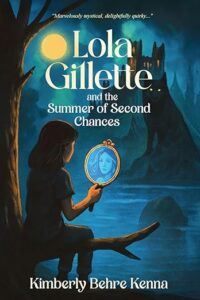 A heartwarming and magical middle-grade adventure about grief, guilt, and the power of connection.
Thirteen-year-old Lola is determined to honor her perfect twin sister, who died in an accident Lola can’t forgive herself for. To make things right, she’s on a mission to complete their Perfect Pairs Collection-but one mistake lands her in serious trouble. Now, instead of facing reform school, Lola must spend August with her eccentric, agoraphobic Uncle Milo in his crumbling mansion on the Connecticut River.
What begins as punishment quickly turns into a summer full of strange discoveries: a Zen garden gone wrong, a holographic projector spitting ghostly messages from her late aunt, a mysterious houseboat, and even a wandering wolf. As Lola races to complete her lucky baker’s dozen of perfect pairs, she starts to realize that magic isn’t about collections or luck-it’s about healing, forgiveness, and finding where she truly belongs.
Perfect for fans of Kate DiCamillo, Lynda Mullaly Hunt, and Anne Ursu, this touching, funny, and imaginative story explores family, loss, and the courage it takes to let go.
BUY HERE
Category: How To and Tips, On Writing
Subscribe
If you enjoyed this article, subscribe to receive more just like it.