Holding Both: Grieving Your Losses While the World Grieves Too
By Shelby Forsythia
At least once a month, it happens.
I’m sitting with a group of grieving people during one of my weekly support calls, speaking into the mic while messages begin to appear in the chat. Someone types what many others are feeling but haven’t found the words to say: “I don’t know how to cope with my grief… with everything happening in the world.”
More messages follow: “Yes.” “Same.” “I’ve been feeling this too.”
Because it’s not just their own losses they’re grieving. It’s the natural disaster on the news. The war that won’t end. The public figure who died suddenly. A too-local act of violence. A headline that lands in the body before it can even be processed and understood in the mind.
It’s grief, layered on grief.
In my work as a grief coach, I’ve named this experience “meta grief”—the grief you feel about the fact that you’re grieving at all, aka “grieving about grieving.”
It’s not just, “I miss them;” it’s, “I’m exhausted that grief is my life now.” It’s the weight of knowing that grief doesn’t arrive once and leave politely. It comes back. It multiplies. It expands to include not just your loss, but the losses unfolding all around you.
And in a world where tragedy is constantly streaming into our hands, it can feel like there’s no boundary between your grief and everyone else’s.
I see people recognize the impact of meta grief in real time, over and over again—not as an abstract concept, but as a lived experience. A moment where someone realizes that what they’re carrying isn’t just their grief—it’s grief about grief. It’s the tiredness and overwhelm
of knowing that loss is not a one-time event paired with the dread of anticipating how much more there will be to feel, to witness, to endure.
One of the most common questions that emerges in these conversations isn’t just “How do I cope?” It’s something much more tender, and much more conflicted: “Am I even allowed to grieve my own losses right now?”
When the world feels like it’s falling apart, personal grief can feel small—indulgent, even. Like something that should be set aside to make room for what is bigger, louder, or more urgent.
And yet, the opposite can also be true. Sometimes the world’s pain is too much to take in. Not because you don’t care, but because you do. Because caring, on top of everything you’re already carrying, feels like it might break you open in a way you’re not sure you can
come back from. So you turn away. You scroll past. You mute the news. You narrow your focus to what’s directly in front of you.
And then comes the guilt. Guilt for grieving your own life when others have it worse. Or guilt for not grieving the world when you feel like you should.
This is the quiet tension so many grievers are living with right now.
But what I remind my clients and students of, again and again, is this: Your heartbreak and the world’s heartbreak are not in competition. They are happening at the same time.
Part of what makes this so difficult is that, once grief enters your life, it changes how you see everything. Loss is no longer something abstract or distant. It becomes recognizable. Immediate. Everywhere.
In my work, I often say that once you’ve experienced grief, it’s like putting on a pair of glasses you can’t take off. You begin to notice it—in systems, in stories, in policies, in the ways people are cared for or not cared for. You begin to understand, on a deeper level, that grief is not just personal. It’s shaped by the world we live in.
The conditions surrounding our losses—healthcare, safety, access to support, the ways certain lives are protected or neglected—are not random. They are influenced by decisions, structures, and systems far beyond any one individual life. Grief, in that sense, is never entirely private. It’s non-negotiably intertwined with the world. And once you see that, it’s impossible to separate your grief from everything else that’s happening.
So the question becomes not “How do I choose between my grief and the world’s grief?”, but “How do I live with both?”
What I’ve learned, both in my own life and in ten years of supporting grieving people, is that the answer is not to resolve this tension, but to give yourself permission to feel it. Sometimes that begins with something as simple—and as radical—as telling the truth about how this feels. This language is based on my book, Of Course I’m Here Right Now: 3 Actually Helpful Things to Say to Someone Grieving—and you can use the phrases with yourself just as much as you can use them with others!
For instance:
- “Of course it’s overwhelming to carry your own loss while witnessing so much loss around you.”
- “I’m here for you as you navigate your grief and the world’s.”
- “Right now, this is a lot to hold.”
“Of course” offers emotional validation.
“I’m here” provides accompaniment in isolation and loneliness.
And “right now” frames this moment as one moment—a difficult one, absolutely, but one singular moment within the entire story of your life.
We are living in a time where grief is constant. Not just in our personal lives, but in the world around us. And if you feel like you are carrying more than you can hold, it does not mean you are doing something wrong.
It means you are paying attention. It means you are human. And it means that you are living in a world where loss is not rare, but ever-present.
If there is anything I hope you take from this, it’s this: You are allowed to grieve your losses, even as the world grieves too. You are allowed to meet yourself, in the middle of all of it, with a kind of compassion that doesn’t ask you to choose between your heartbreak and the world breaking open.
To you I say: Of course you feel this way. I’m here, and I will not forget you are grieving. And, right now, this is exactly as hard as you think it is.
And you are not the only one carrying it.
—
Shelby Forsythia is the author of Of Course I’m Here Right Now: Three Actually Helpful Things to Say to Someone Grieving (Broadleaf 2026). She is also a grief coach, author, podcast host, and founder of Life After Loss Academy. Through mindfulness tools and intuitive guidance, she helps people welcome grief as a teacher and create lives that honor their heartbreaks. Her work has been featured in HuffPost, Bustle, and O, The Oprah Magazine. She lives in Chicago, Illinois.
Of Course I’m Here Right Now: Three Actually Helpful Things to Say to Someone Grieving
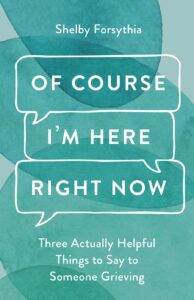 What do I say to someone who is grieving?
When someone we love is grieving, we want to help, but we often don’t know what to say. “I’m sorry” feels empty. “Let me know if there’s anything I can do” puts pressure on them to ask. “Time heals all” only makes things worse. But what if, instead of avoiding the conversation or saying something unintentionally hurtful, you had three simple phrases that reliably offer comfort?
Of Course I’m Here Right Now is your guidebook to supporting a grieving friend, family member, client, or anyone who’s grieving, and doing so with confidence and compassion. Here, experienced grief coach Shelby Forsythia introduces three essential phrases that, when used appropriately, can provide immediate relief and long-term reassurance.
Through real-life examples, practical scripts, and a sensitive, compassion-first approach, this book equips you to say something truly meaningful even when words feel inadequate, to show up for the grieving person in a way that strengthens your relationship, and to stop second-guessing yourself as you offer comfort that resonates.
Whether you’re consoling someone after a death, divorce, diagnosis, or another loss, Of Course I’m Here Right Now ensures you’ll never be at a loss for words again.
BUY HERE
Category: On Writing
Subscribe
If you enjoyed this article, subscribe to receive more just like it.