Plots and Paper; Scissors and Scenes… by Susan Kleinman
By Susan Kleinman
“So,” the interviewer asks me, “what do you do when you’re not writing?”
The first three answers that come to mind—I doomscroll, I cook dinner, I complain about having to cook dinner—don’t reflect terribly well on me, so I jump down to item #4 on the list and tell her that I make collages.
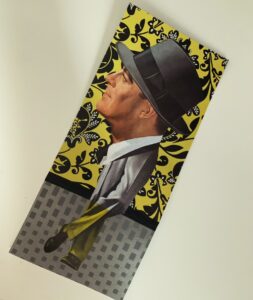 I started collaging during COVID. With too much time on my hands and too many catalogs in my mailbox, I started cutting out pictures and gluing them to paper to make cards for locked-down friends. When recipients started referring to my creations as “art,” I began making collages to frame and give as gifts.
I show the interviewer some of the pieces I’ve made, and she oohs and ahhs. Then, in my most teacherly tone, I say, “As I always tell students in my ‘Overcoming Writer’s Block’ seminars, it’s important to have a hobby that is nothing at all like writing. Absolutely critical.”
It was only after the interview ended that it dawned on me: My art is actually NOT an entirely different thing from my writing. The way I craft collages and the way I write stories are—how had I not realized this before!?—almost identical.
When I make collages, I aim to mix enough different elements to create interest, but not so many as to cause chaos. And I often find myself removing pieces from a composition that looks too chock-a-block. So, too in writing: I endeavor to create enough characters who are different enough from one another to keep things interesting—but not so many that the reader feels overwhelmed. My novel, All Afternoon, starts with a dinner party gone sideways. In my first draft, there were eight guests. But as I worked on the scene, I realized that I had to streamline the cast of characters so that each of them had his or her moment in the spotlight, and two of the guests ended up on the cutting-room floor. Like my collages, my novel benefitted from paring down and cutting back.
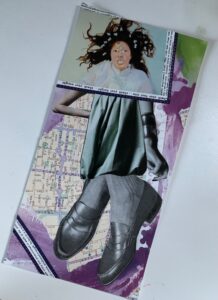 In my collages and in my fiction alike, I source my materials from myriad places. I gather my collage “ingredients” from magazines, art books, ephemera, and old wallpaper sample books. For my stories, I pull from memories, overheard conversations, what-ifs, and my imagination. The idea for the dinner party at which a professor’s colleagues are nasty to his wife came from a story a real-life professor’s wife shared with me years ago, about a visiting lecturer at her husband’s college who came to dinner and spent the whole night making fun of her for being “only” a wife and mother. All Afternoon’s protagonist, Marilyn Weisfeld, has a very different personality from my friend’s, but that little snippet from my friend’s life evolved into a whole book full of ideas, incidents, and conflicts unrelated to the first piece I laid down, just as a scrap of paper becomes something more when I start adding other materials.
Sometimes, I find what I need to enrich a creation right at hand. For my collages, I might flip through yesterday’s newspaper to find pictures. For my novel, I browsed through my childhood memories. Marilyn’s daughter’s quirky hobbies—making up parody songs, designing “dream houses” on graph paper—are things I did at her age. And a recurring bit in All Afternoon about “doctored up” cake mixes recalls my own mother’s go-to dessert strategy circa 1978, when the novel takes place.
When writing, as when making art, the most important question I ask myself is “What if….?” What if I add rubber-stamped images on top of magazine cutouts? (That became a birthday-card for my brother.) What if Henry Goldfarb, the famous novelist who sets off the book’s chain of events by inviting Marilyn to a reading in the city, invites her up to his apartment for lunch after the event? And what if she starts sneaking into the city to have lunch with him week after week? The answers to those “what-is” became central to the plot of All Afternoon.
But in novel-writing as in collage, collecting the right elements—photos, textures, and patterns or characters, storyline, and conflict—is only a small part of the work. The more important challenge is arranging those scraps and snapshots, or personalities and plot points, into the right configuration… and then looking carefully at the (literal or figurative) picture, evaluating what’s missing and adding it, deciding what’s superfluous and eliminating it.
Sometimes, I can see immediately what isn’t quite working and fix it easily. But sometimes, a piece has to sit for months or even years before I can figure out what the problem is—and how I might solve it. I recently revisited a collage I had given up on at the beginning of the pandemic. When I turned it ninety degrees to the right, it looked entirely different—and so much better. And that six-year lag was nothing compared to the seventeen years of writing, rewriting, giving up, trying again, and getting feedback from “fresh eyes” before I understood that All Afternoon was missing a crucial scene near the end of the novel.
Writing and collaging. Different arts, but, as it turns out, identical techniques. So, the next time an interviewer asks what I do when I’m not writing, I’ll say, “I do something that is almost exactly like writing… and also, I complain about cooking dinner.”
—
Susan Kleinman’s writing has appeared in The American Literary Review, CRAFT Literary, JewishFiction.com, House Beaut
Instagram: @Susan_Kleinman
Facebook: Susan Kleinman
ALL AFTERNOON
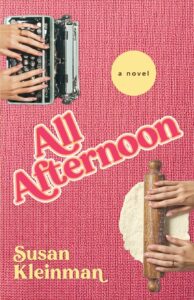 River Ridge, New Jersey, 1978: As feminism takes root in this tight-knit Modern Orthodox community, women are starting businesses, rethinking their marriages, and challenging their synagogue’s long-standing rules.
Not Marilyn Weisfeld.
Once a promising writer, Marilyn gave up her literary dreams twenty years ago when she married Jerry, a self-important professor of economics. Now, she’s too busy raising children, braiding challahs, and entertaining her husband’s insufferable colleagues to think about what else her life might have held… until the night an old friend comes to dinner.
When bestselling author Henry Goldfarb asks for Marilyn’s feedback on his new novel, something long buried inside her stirs back to life. And when he encourages her to write again, she starts sneaking into Manhattan every week to see him. In long afternoons of shared stories, easy laughter, and soul-baring conversations, Marilyn catches glimpses of a more fulfilling life she could be living – if only she can find the courage to reach for it.
But change always comes at a cost. And as Marilyn’s feelings for Henry begin to blur boundaries and test loyalties, the tidy existence she has woven so carefully in River Ridge begins to unravel. Caught between the comfort of old rhythms and the thrill of new possibilities, she will have to decide exactly what price she’s willing to pay to live bravely, authentically, and without regret.
Warmhearted, funny, and relatable, All Afternoon is a powerful debut about the quiet ache of losing yourself and the courageous work of finding your way back.
BUY HERE
Category: How To and Tips
Subscribe
If you enjoyed this article, subscribe to receive more just like it.