How Unburned Came to Be by Sarah Oelschig
Unburned: A Slightly Messy, Mostly Honest Guide to Life After Burnout, by Sarah Oelschig
Unburned didn’t begin with a plan. It began with a piano.
In the middle of 2022, I was deep in what I now know was burnout, though I didn’t have a name for it yet. As an HR leader, my job was to help others through situations like this, but I didn’t notice it within myself.
I was snapping at my kids. My husband and I spoke in logistics, like two people managing a shared project. I remember staying in a video meeting after everyone else had left, my hands suspended above the keyboard, unable to remember what I was supposed to do next.
During one of the venting conversations that counted as socializing back then, a friend asked me something so unexpected I thought she’d misheard me: What did you like to do when you were little?
I stared at her. After a while, I remembered: bikes, books, the swings at the park…and the piano. I’d spent my life savings on a piano in my 20s, but for years it sat in the corner of my living room, silent and almost judging me.
It took me a few days to get up the courage to sit down at it. When I finally did, it was a disaster. I struggled through a Debussy piece I used to love, shoving myself away from the keyboard in frustration. Eventually, I tried again. My breathing slowed, my shoulders relaxed, and by the time I finished, something had changed. I experienced a quiet sense of recognition, like being reintroduced to a piece of myself I thought was gone.
That was the moment the book really began. I realized, deep down, that burnout doesn’t just wear you out; it makes you forget who you are. Recovering is the process of coming back to yourself.
Writing vs. Editing
To my surprise, writing was the easy part. I wrote quickly and instinctively in the early mornings before the house woke up, drawing on journal entries, random notes, and conversations with clients and colleagues. The words came readily because they were simply true: the Diet Coke and Junior Mints lunches, the driveway I couldn’t make myself leave, the feeling of being two people at once: the functional one and the one underneath quietly falling apart.
I wasn’t prepared for the editing.
The first hard thing was the gap between writing something true and believing I had the right to publish it. There’s a particular kind of imposter syndrome that comes not just from doubting your expertise, but from doubting your lived experience, as though surviving something and seriously thinking about it for two years still doesn’t quite make you qualified to speak about it. My inner critic, which I write about at length in the book, had loud opinions about this. It auditioned several versions of the argument that I should probably just keep this to myself.
The second hard thing was Chapter 1, and specifically a passage involving my mother. She appears briefly but honestly, and there’s a gap between what’s true and what feels safe to share about someone you love, particularly someone who didn’t ask to be in your book. When I wrote those lines, I was trying to explain my lifelong relationship with burnout. I had thought that putting myself last was simply the right way to be an adult. I still think about whether I should have kept those lines in.
The beta readers showed up like a weather event I’d intellectually prepared for but was emotionally not ready for at all.
Some feedback was immediately useful, and some feedback was harder to accept. A few readers felt the section on cell phone boundaries was unrealistic, too prescriptive, and impossible in 2025. What do you do if you have kids?! They weren’t wrong that the advice was ambitious, but it’s important to reckon with how much time and attention we surrender to the mini-computers bouncing around in our pockets all day. In the end, I kept the section and softened the framing, accepting the difficulty rather than presenting the boundary as a simple fix.
And then there were the jokes…not everyone got them. A few readers flagged the humor as jarring, unexpected in a book about something so serious. I understood the concern but didn’t take their notes. Burnout is serious. It’s also, in places, absurd, like the coworker who snaps at you over an errant comma, the inbox that multiplies like rabbits, and the dog whose cheerful request for a walk is, at peak burnout, simply too much to bear. If I had edited the humor out, I would have edited out something true: the part that says you can hold the burden of this and laugh at parts of it. In fact, you probably need to.
What I Learned
Writing a book about burnout while you’re still inside of it is a strange and occasionally vertiginous experience. I took my own burnout inventory midway through the process and scored a 35 out of 50. That was equally humbling and clarifying. I was standing on the other side of a door I hadn’t fully closed.
The book is better because of that. It’s honest in ways a more polished version of me might have softened. It says things I needed to hear but couldn’t find anywhere else.
That’s why Unburned exists. I had something I couldn’t stop thinking about, and writing it down was the only way I knew to finally put it somewhere outside myself.
* * *
Sarah Oelschig is a human resources leader, certified professional coach, and trained counselor whose career has centered on helping people navigate workplace exhaustion, transitions, and the inner critic. She holds an M.A. in Counseling Psychology from the University of San Francisco and a Professional Coaching for Life and Work Certificate from UC Davis. Her new book is Unburned: A Slightly Messy, Mostly Honest Guide to Life After Burnout. Learn more at sarahoelschigcoaching.com.
Unburned: A Slightly Messy, Mostly Honest Guide to Life After Burnout
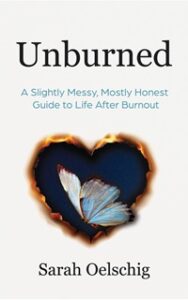 Unburned: What Comes After Burnout
A practical, science-backed, and empowering guide to recovering from burnout, rebuilding your identity, and creating a life that feels like yours again.
If you’re exhausted, overwhelmed, and stuck in survival mode, you’re not alone – and you’re not broken. Burnout is everywhere, but no one talks about what comes after the crash.
Unburned is an empathetic, funny, and research-driven roadmap for anyone ready to heal from burnout and rediscover who they are. Instead of telling you to “optimize your morning routine” or meditate your stress away, coach and HR leader Sarah Oelschig helps you untangle the emotional, psychological, and cultural forces that fuel burnout—and shows you how to recover in a way that’s actually sustainable.
Inside, you’ll learn how to:
- Reconnect with your identity when burnout has stripped it away.
- Set healthy boundaries without guilt.
- Break cycles of overworking and people-pleasing.
- Rebuild joy, confidence, and meaning.
- Create a life that supports your wellbeing (not the other way around).
Filled with relatable stories, evidence-based insights, and practical tools for everyday resilience, Unburned is for anyone navigating chronic stress, work fatigue, compassion fatigue, emotional exhaustion, overwhelm, or the long tail of burnout.
If you’ve ever whispered, “I hate this place,” this book will remind you: burnout may shut one door, but it can open a much better one.
BUY HERE
Category: On Writing
Subscribe
If you enjoyed this article, subscribe to receive more just like it.