Midwifing The Writer
By Sarah Branson
 The contractions wake her just after midnight. At first, she just feels niggly little cramps waking her every few minutes, keeping her from deep sleep. Eager to have the process underway, she crawls from under her covers and putters about her home excitedly envisioning her coming child and nervously anticipating the work that lies before her.
Night gives way to dawn, and her contractions strengthen, lengthen, and demand her full attention. Her breathing comes in deep inhales, blown out with the shakiness that results as the body and mind battle between control and release. Her damp hair is a testament to her work, sweat accumulating in salty beads at her hairline and on her upper lip. She is focused, coping, no longer chatty between contractions. She is turned inward, riding each wave, drawing on reserves she didn’t know she had. Her cervix dilates in earnest—five centimeters, six, seven, eight—and then… nothing. Two hours pass. Three. Four. Her cervix refuses to budge even a millimeter.
But inside, everything is happening.
Her baby is rotating a few degrees at a time, searching for the perfect angle to descend. Her pelvis is loosening and shifting, the ligaments relaxing to make room. Her uterus continues its rhythmic work, even if the progress isn’t visible on the paper chart. Her hormones are adjusting, her body calibrating for the enormous work ahead.
From the outside? It looks like failure. Arrest of dilation.
From the inside? It’s essential preparation.
In my thirty plus years as a midwife, I’ve seen just about every version of labor imaginable—fast, slow, silent, roaring, textbook, and wildly inventive. But one of the most common, and least appreciated, patterns is what we midwives call “the eight-centimeter stall.”
I didn’t realize until I became a novelist that this eight-centimeter stall is the perfect metaphor for writer’s block.
Writers love measurable progress. We adore our word counts, our pages edited, our Scrivener color-coding, our daily streaks. A good writing day is one where the number gets bigger.
But some days—and sometimes for long stretches—that number doesn’t move.
We sit at the keyboard and feel… stuck. Like something inside us is trying to advance but has suddenly frozen. We call it writer’s block, and then we immediately call it a problem. A failure. A lack of discipline. A sign that we aren’t real writers, or that maybe the book was a bad idea, or that someone else could do this better.
But here’s what midwifery taught me: just because you can’t measure progress doesn’t mean progress isn’t happening.
When my cervix-stalled mamas hit that long plateau, I never panicked. I didn’t scold their bodies. I didn’t tell them they weren’t working hard enough. I didn’t hand them a deadline or a guilt trip.
I simply supported them while their internal world aligned itself for the next big step.
Writing is no different. When I’m “stuck” in my writing life, it rarely means nothing is happening. It means something is happening that isn’t measurable by word count.
Maybe the character arc hasn’t snapped into place yet.
Maybe the backstory is unspooling quietly in the background.
Maybe I haven’t yet admitted to myself what the emotional heart of the scene really is.
Maybe the plot needs to rotate a few degrees—just like that baby searching for the correct position.
During the writing of my Pirates of New Earth adult series or when I was drafting my newest YA novel For the Love of Glitter, I would sometimes go days—weeks even—without writing more than scattered sentences. I’d pace. I’d bake. I’d scribble half-thoughts in a notebook. I’d stare at my characters and think, Why won’t you tell me what you want?
It felt like failure. Arrest of the story.
But in retrospect, those were the moments when the story was shifting into alignment. Characters were deepening, motivations clarifying, emotional stakes sharpening. I wasn’t stuck. I was preparing.
Writers don’t always respect preparation because it doesn’t look productive. But labor taught me that the most important progress often happens beneath the surface.
In midwifery, when a woman is stalled at eight centimeters, I don’t tell her to try harder. That would be cruel—and dangerous. Instead, we shift positions. Side-lying. Hands-and-knees. Leaning over a birth ball. Walking. Resting. Hydrotherapy. Whatever helps her body realign.
Writers need position changes, too.
When the words aren’t coming, sometimes the best thing you can do is step away from the page. Not in defeat, but in trust.
Try writing longhand instead of typing.
Take a walk without headphones and let your characters talk to you.
Act out the scene.
Interview your antagonist.
Write a letter from one character to another.
Or simply rest your creative muscles and let the story breathe.
These aren’t distractions. They’re position changes—ways of helping the story rotate into the right spot so it can descend.
One of the most radical lessons birth taught me is that patience is an active skill. It’s not sitting with folded hands. It’s supporting someone through the messy middle, even when nothing looks different from the outside.
Writers can cultivate that same patience with ourselves. We can remind ourselves, “You are not stuck. You are preparing.”
Trusting that allows you to stay open, curious, and grounded rather than spiraling into self-critique. And when you stop fighting your stall, you often move through it faster.
If you’ve ever labored or witnessed labor, you know the unmistakable moment when things start to change. The mother feels pressure. Her body shakes. She looks up with wild eyes and says, “Something’s different.”
Writers have that moment too.
A character suddenly confesses something you didn’t know. A plotline clicks. A sentence tumbles out that feels like a door unlocking. And suddenly you’re writing again—not out of force, but out of flow.
Some of my best writing days have happened right after my most barren ones.
Birth taught me to trust that progress is happening even when we can’t measure it. Writing has taught me the same.
So, if you find yourself staring at a blinking cursor, convinced you’ve failed because your word count hasn’t budged, remember the women at eight centimeters—working, shifting, preparing for transformation, even when the chart suggested stillness.
Your story is moving. Your characters are aligning. Your creative pelvis is widening. You are, in ways both quiet and profound, getting ready.
The breakthrough will come. Babies always do.
—
Sarah Branson is an award-winning author of feminist speculative fiction filled with action, resilience, and romance. Her debut, A Merry Life, launched the four-book Pirates of New Earth series, winner of the 2022 Kindle Book Award for Science Fiction. She followed with North Country: A Kat Wallace Adventure for adults and has expanded her world with younger voices in the YA Unfurling the Sails, the middle-grade A Pirates’ Pact, and her newest YA release, For the Love of Glitter. A former midwife and lifelong traveler, Sarah now lives in Connecticut, where she writes stories celebrating the strength of the human spirit. You can find her at sarahbranson.com
FOR THE LOVE OF GLITTER
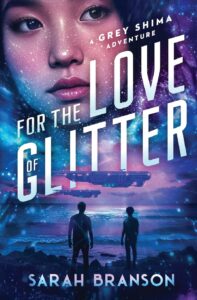 A rebellious heart. A tempestuous romance. A plot that could bring down a nation. In Bosch, loyalty isn’t just earned—it’s tested.
Grey Shima has her future all planned out: graduate, enlist, and follow in the footsteps of her fearless mother, Master Commander Kat Wallace. But when Grey meets the magnetic and passionate Edmund Sinclair, her world tilts.
He’s not just another boy with good hair and dangerous ideas—he’s a revolutionary, dead set on exposing the ugly truth behind the glittering power that fuels Bosch. Caught between love and legacy, Grey finds herself questioning everything: her training, her purpose, and her heart.
But she’s not alone. Sy Mercer, Grey’s best friend, has stood by her side throughout her childhood. Smart, steady, and secretly in love with her, Sy sees the danger Grey can’t—or won’t—acknowledge. As Grey spirals deeper into a movement that may not be what it seems, Sy must confront his own fears and decide how far he’s willing to go to protect her… even if it means losing her.
Because love, like revolution, is rarely without sacrifice.
In a postapocalyptic world rebuilding from ruin, For the Love of Glitter is a YA speculative romance about betrayal, resistance, and finding your true north—even when everything else is falling apart.
BUY HERE
Category: On Writing
Subscribe
If you enjoyed this article, subscribe to receive more just like it.