Nature’s Blueprint for Organizational Design
By Ines Garcia
 Sometimes the most profound realizations come not from seeking answers, but from recognizing patterns we’ve been experiencing all along.
In 2021, I found myself at an intersection. As a circular economy professional, agile and organizational coach, I’d spent years helping teams and organizations navigate change, build resilience, and discover new ways of working. Yet despite meaningful progress with individual clients, I kept encountering the same fundamental challenges: teams operating in silos, organizations struggling with collaboration across boundaries, and leaders seeking sustainable ways to innovate and grow.
I knew the answers weren’t going to come from the same frameworks and methodologies we’d been recycling for decades. We needed to look elsewhere; somewhere that had actually solved these challenges over vast timescales.
When Nature Became the Teacher
That year, I enrolled in a six-month biomimicry program. Biomimicry, in short, is learning from nature’s proven mechanisms and strategies. This had fascinated me for years, but I’d primarily encountered it in technological contexts: Velcro inspired by burrs, bullet trains shaped like kingfisher beaks, building ventilation systems modeled on termite mounds. Brilliant innovations, certainly, but my questions centered on something different: organizational design, connectivity, collaboration, and resilience.
What if we looked at how natural systems organize themselves? How do ecosystems coordinate complex activities? How do forests maintain resilience through disruptions? What enables coral reefs to support extraordinary biodiversity in resource-limited environments?
The research journey revealed something I hadn’t anticipated. The most dynamic, productive, and resilient spaces in natural systems aren’t found at their centers–they flourish at the edges. Where forest meets meadow, where river encounters land, where different habitats intersect, that’s where abundance explodes. These “edge effects” support species that couldn’t survive in either pure environment alone. They generate innovations neither ecosystem could produce independently.
This realization struck me with recognition, rather than discovery. I’d been observing edge dynamics my entire career without naming them. The most innovative solutions emerged when different disciplines collaborated. The strongest teams were those with diverse perspectives. The most resilient organizations maintained permeable boundaries rather than rigid silos.
“Nature has been demonstrating these principles for 3.8 billion years. We just needed to learn how to read the patterns.”
One truth became immediately apparent: knowledge without application serves no one. I could share these insights through individual coaching sessions, conference talks, or workshops. But these approaches, valuable as they are, reach people one conversation, one session, one talk at a time. Meanwhile, organizations everywhere were struggling with the same fundamental challenges–challenges that nature had already solved.
This is my fifth book, so the writing process itself wasn’t unfamiliar territory. What felt different was the urgent sense that this knowledge needed to reach people in a format they could reference, return to, and implement at their own pace. Not just theoretical understanding, but practical, actionable guidance grounded in both natural principles and real-world application.
The book took shape around a central challenge: How do we move from theoretical agreement to tangible action? Everyone nods enthusiastically when you explain that organizations should operate more like ecosystems. But what does that actually mean on Monday morning when you’re facing a deadline with three departments who can’t agree on priorities?
Writing at the Edges
I structured the book deliberately to bridge this gap between inspiration and implementation. Six parts, each exploring specific properties that edges provide in natural systems and how those properties translate into principles for human organizations. But theory alone wouldn’t suffice.
Throughout the book, readers encounter “In Practice” examples, these are practitioners who are actually evolving their organizations using these principles. From a bioinspired consultant redesigning workplace cultures to mirror rainforest ecosystems, to a public health practitioner applying swarm intelligence to team coordination, to educators using nature’s teaching strategies in overwhelmed school systems. These aren’t hypothetical scenarios; they’re real people doing real work, demonstrating that nature-inspired organizational design isn’t aspirational, it’s achievable.
Each section follows a pattern: observe human stories and interactions, explore what nature demonstrates, then consider how we might blend the best of both to “nurture human nature.” Because that’s the insight: humans aren’t separate from nature. We are nature. We’re governed by the same natural laws, the same principles, the same patterns, the same fundamental strategies that enable thriving systems.
The writing process itself reflected these principles. I applied Agile to crafting the book, something I’ve refined over five books and now share with other authors I mentor. Short iterations, continuous feedback, adaptive planning, etc. Not coincidentally, these mirror how natural systems evolve: test, observe, adjust, repeat.
This book was humanly written and words carefully chosen. In an era where content proliferates, I wonder how many books are still being crafted this way–with human attention to nuance, metaphor, and the subtle art of making complex ideas accessible without oversimplifying them.
The journey from research-to-published book taught me something about edges themselves. This book exists at the intersection of multiple domains: biomimicry and business, science and practical application, natural observation, and organizational design. These edges weren’t barriers to overcome but rather sources of creative tension that shaped the work.
Writing for practitioners meant translating ecological concepts without losing scientific rigor. Including diverse practitioner voices meant coordinating across continents and disciplines. Balancing actionable guidance with deeper systems thinking required constant calibration.
Yet these edge tensions generated exactly what the book advocates—innovation, resilience, and abundance that wouldn’t have emerged from any single perspective alone.
“This book represents an invitation more than a conclusion.”
This is an invitation to notice the edges in your own organization—those overlooked spaces where teams intersect, where different disciplines meet, where your organization encounters external partners and communities. An invitation to see these not as problems to be managed but as opportunities to be cultivated.
This is an invitation to look outside your window at the natural world that has been demonstrating successful organizational strategies since long before humans existed. An invitation to recognize that we don’t need to invent new paradigms from scratch; we simply need to learn to read the patterns that surround us.
Most importantly, this is an invitation to move from agreement to action. Because the world’s challenges won’t be solved by theories, no matter how elegant. They’ll be addressed by people willing to experiment, adapt, and apply wisdom that’s been tested across billions of years of evolution.
The question is: Are you ready to be part of the solution?
***
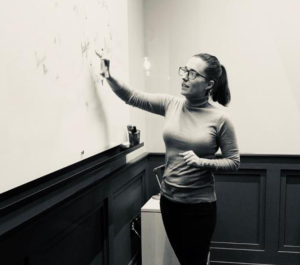 Ines Garcia is an organizational coach and the Founder and CEO at Get Agile, dedicated to helping businesses to deliver better value and reduce waste, focusing on impact. Her new book is Nature’s Blueprint For Business: Harnessing the Hidden Power of Edges (Routledge; September 8, 2025). She offers hands-on programs for Agile, Project, and Product professionals at www.inesgarcia.me.
Category: On Writing
Subscribe
If you enjoyed this article, subscribe to receive more just like it.