Writing About World Peace: What My Fantasy Trilogy Taught Me About Human Nature
By Reni Stankova
For 30 years, I wholeheartedly believed our world was heading toward world peace. Naive, I know. No one thinks of world peace when looking at the state of politics today.
I am a millennial from Eastern Europe, born in the fateful year of 1989. It was the year when the communist regime in my home country of Bulgaria fell, and my generation was lovingly named “the children of transition”. While my parents struggled with the chaos of our new and supposedly better economy, I was blissfully enjoying imported junk food and learning English from the age of six, thanks to untranslated Western cable TV.
I grew up progressive and open-minded. Discrimination was a dirty word. I became an LGBTQ ally as soon as I understood what sexual orientation was. Women could do anything. After all, I was one with big dreams ahead. Michael Jackson’s Earth Song and Heal the World made me cry; they were my personal anthems.
Sure, I knew violent conflicts in other countries existed, but they seemed localized and temporary. There weren’t century-long wars anymore. Country borders were already decided. Countries today seek profit, not conquest. Peace was profitable because capitalism needed consumers.
Well, my naive belief was shattered in the mid-2010s. So, what does a disillusioned millennial do? She writes an LGBTQ political fantasy about world peace.
When I wrote The Enemy of Heaven and later The Secrets of Heaven, I imagined a post-war world where all country borders have fallen and the surviving population has united into one country. World peace reigned for the first time in human history, so this new united world was named Heaven. And every citizen of Heaven was an angel.
In my books, angels are regular people; however, after a thousand years, they have turned into a social class, the majority. While the minority, the demons and the virtues, lived outside the norms. The demons were second-class citizens, and the virtues were hailed as divine beings and the founders of the world religion.
Immediately, you see the conflict, don’t you?
Even when I write about a utopia, I still cannot imagine the absence of discrimination, corruption, and unjust hierarchies. Even my childish, optimistic old self somehow knew people would always find reasons to be divided.
I imagined a race of red-eyed people shoved to live in ghettos with no prospects of a better life. They endure police brutality by the so-called “guardian angels”. The concept of world peace is at the center of Heaven’s constitution. And every crime judged to be a “threat to world peace” gets the perpetrator the title an enemy of Heaven, which is followed by the death penalty.
And, the only ones who get executed are the demons, the lowest class.
The most powerful angels pull the strings of corruption. And in the center is Raphael, an angel prince and a social justice warrior, who seeks to disrupt the status quo from within the system. He gets his chance by recruiting a skillful demon from the ghetto named Dante. And eventually their mission turns into love.
Raphael is very close to my heart. Knowing the history of his kingdom and all the awful things his ancestors did in the name of world peace, he is disillusioned with reality, just like me. There were no wars for a thousand years, yet he feels the weight of injustice beneath the surface of paradise and deeply suffers with historical guilt.
In him, I recognized something I hadn’t admitted to myself: despite wanting world peace, subconsciously, I didn’t trust it.
I am a writer. I am the god of this world. I can create whatever I want. I can put logic anywhere I decide. I wanted to write about world peace, yet in the end, I still wrote about our current problems, only in a different time. I had imagined an end to conflict, but not to inequality. Because, no matter how progressive I believe myself to be, deep down, inequality feels normal.
Every author is the product of their time, and this trilogy has made me into one of the many examples. After The Children of Heaven, the third and last book of the trilogy, was finished, I brought the story to a close by laser-focusing on Raphael and Dante’s unbreakable bond. Because in the end, we the people make the world a better place by making our direct surroundings into our own personal Heaven.
So, spoiler alert, I did not solve world peace in this gay fantasy trilogy. I dared to play with a profound idea, and my work became a mirror reflecting the limits of my own longing.
One day, I might write a story that truly envisions world peace, an ideal world so distant from reality that it becomes the pure escapism I’ve always aimed for. Until then, I’ll keep mending imaginary conflicts as best I can. For now, that’s enough.
—
Reni Stankova is a bilingual author from Bulgaria. Her works include The Heaven Trilogy, an LGBTQ fantasy epic; Sirma, a historical fiction novel inspired by a Bulgarian historical figure; and The Novel Outline Toolkit, a book and journal bundle for writers.
Book Shop: https://payhip.com/ReniStankova
Instagram: https://www.instagram.com/reniwritesfantasy/
Newsletter: https://www.renistankova.com/subscribe/
The Children of Heaven
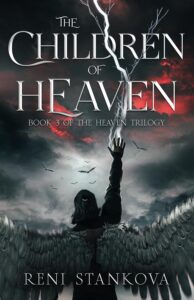 To build a better world, they must first burn the old one down.
Michael Azelys has awakened a long-forgotten power, and for the first time in a thousand years, angels, demons, and virtues clash in a brutal uprising, reminiscent of the Great War.
Determined to stop his brother, Raphael becomes the key to ending the centuries-long oppression of demonkind. He will return free will to the demons, or die trying.
Far away, Dante braves the desolate Impact Land in search of other awakened demons like himself. What he discovers exceeds his wildest hopes. But will he return in time, with an army strong enough to stop Michael Azelys, and save his loved ones?
As Heaven crumbles and distance tests their bond, Raphael and Dante must face their greatest fears and decide what they’re willing to sacrifice.
Will they survive long enough to meet each other again?
The Children of Heaven is the explosive finale of the Heaven Trilogy—a queer fantasy of forbidden love, apocalyptic stakes, and a defiant angel/demon love story that reshapes worlds.
BUY HERE
Category: On Writing
Subscribe
If you enjoyed this article, subscribe to receive more just like it.