The Origin Story: Soul Toll, For Anyone Who Has Ever Wondered if Success is Enough
By Anusia Gillespie
At 29, I quit my law firm job with six-figure debt and no backup plan. Something had shifted. A meditation as part of a 200-hour Yoga Teacher Training program cracked something open in me, like a champagne cork popping, and there was no going back. It was as if I’d glimpsed behind the curtain of the life I was building, and once I saw the game for what it was, I realized it was a ladder I had no interest in climbing.
For many, this happens over time. For me, it happened overnight.
In the days that followed, something unexpected happened. Senior partners — people I admired and feared in equal measure — stopped by my office to ask their version of the question: “Can I come with you?” They laughed as they said it, but I could tell they meant it more than they let on. I realized I wasn’t the only one questioning things. I’d just been the first to act on it.
The experience of stepping off the well-worn path was disorienting. A grounding force, though, was the sense of responsibility I felt to help others cultivate more agency in their lives, before they missed out on themselves. That drive came through in my work supporting women lawyers, which eventually led to a life-advancing, mind-expanding role developing leadership programs at Harvard Executive Education.
That series of events sparked the idea for my book, Soul Toll. But the writing didn’t come right away. I still had a lot to learn before I could translate the insights and skills needed to step off the beaten path into a novel.
For years, I tried to get ahead by reading nonfiction, chasing clarity through frameworks and strategies, but those only got me so far. I craved a genre that could fuel my ambition, feed my soul, and spark my imagination. Most nonfiction felt too dry. Most fiction didn’t apply directly enough to my world to leave me changed.
Something was missing from existing works. At the time, I would’ve said it was creativity, but I’ve come to realize it was emotion. How can you expect to influence someone’s behavior without tapping into how they feel?
Two things eventually clicked: The Untethered Soul by Michael Singer, which delivered profound life lessons through metaphor, and the case study method I worked with at Harvard Executive Education. I saw how adults engage differently with narrative — how they can wrestle with decisions, examine tradeoffs, and reach meaningful insight through story.
Wait — Harvard’s case study method has something in common with a contemporary fantasy novel? Yes.
The Harvard case study method is a teaching approach that uses real-world narratives to place learners in the role of decision-makers, encouraging critical thinking through discussion and reflection.
In my day job, I watched executives debate ethical dilemmas and complex leadership choices by stepping into someone else’s shoes. The best case studies created just enough distance to allow for deep personal reflection. The same is true in fiction.
After writing Soul Toll and searching for comparables for the query letter, I discovered The Midnight Library by Matt Haig — a novel that invites readers to explore alternate versions of a life through fantastical means — and saw a similar vehicle. Like a great case study, it didn’t preach. It prompted reflection. But while The Midnight Library looks backward, Soul Toll looks ahead. It’s about what happens next when you finally listen to the part of yourself you’ve been ignoring.
The Writing Process
The process was anything but linear. I completed my first 65,000-word manuscript in 2021 and submitted it for a professional developmental edit through Reedsy. The experience was overwhelmingly positive — the feedback was thoughtful, the edit itself was top-notch — and I now joke that the editor not only helped me make foundational decisions, she also handed me four years of homework.
Still, I scrapped the entire thing.
I had to. I’d made fundamental decisions like changing the point of view and moving from present to past tense. And, I realized I still had work to do. I wasn’t yet the writer I needed to be to bring this story to life.
So I started over, this time with a clear commitment to learning the craft of fiction.
I took courses, including Tom Bromley’s intensive novel-writing program on Reedsy and Disney’s Imagineering in a Box. I studied On Writing by Stephen King and Immersive Storytelling by Margaret Chandra Kerrison. I mapped every beat using the Hero’s Journey and Save the Cat! I built a 4-hour emotional journey playlist and visually storyboarded the novel in a deck.
I also became a mother, and learned to work in small pockets of time in the early mornings, during weekend naps, and in the odd quiet moment of new parenthood.
And then, before I wrote a single word of the new manuscript, I hired a writing coach to work with me every step of the way. I wasn’t going to write and scrap a second one.
I worked with a writing coach on each section as I drafted. Once I felt more confident, I hosted interactive feedback sessions — essentially narrated “book screenings” using the PowerPoint deck I’d created — to understand what resonated, what questions lingered, and most importantly, how readers felt at the beginning and end of the story. What was the emotional shift?
Then I revised. Again and again.
Once I had a strong manuscript, I pursued the traditional path, knowing it’s a tough road for genre-blending work. I wrote a query letter and submitted it to agents for a few months. Eventually, I realized I could either keep hoping someone said yes or start building the book and its platform myself.
And in keeping with the spirit of Soul Toll — and the path I’ve chosen in my own life — the decision was clear: I wouldn’t be limited by the traditional path.
That decision lifted the fear and lingering need for approval and opened the door to a wave of new opportunities. I began sharing the journey publicly. I found early readers on LinkedIn who volunteered to read the manuscript and offer feedback. Some became champions. Others offered quotes that now appear on the back cover. I worked with a cover designer, then returned to my original 2021 editor for a full developmental pass in 2025. That led to a rewrite of the first two chapters, which was overwhelming at the outset — the opening! — but worth it.
After one more round with my writing coach, I finalized the manuscript. I worked with an interior formatter to prepare for print and digital distribution. I printed my first advanced reader copies through IngramSpark and distributed the eBook via BookSirens.
Today, I’m collecting feedback ahead of my October 2025 launch.
The Value Proposition
I wrote Soul Toll to make sense of my own wake-up call, and ended up creating a contemporary fantasy rooted in real-world ambition, systems, and fears. It’s for anyone who’s ever looked around and realized they’ve been living by someone else’s definition of success.
The story explores what happens when the pursuit starts to cost more than it’s worth.
- What tradeoffs am I making for the life I think I want?
- Am I building the life that I want, or that I’ve been told to want?
- Is the version of me that’s succeeding someone I’m proud of?
- Once I can say I’ve succeeded, will it be enough, or will the goal line move again?
Soul Toll offers you the courage to pave your own path in a world that tells you who to be.
I’m not saying you have to quit your job to reclaim your life. I still work full-time, pioneering a new and exciting career in legal innovation. I still juggle motherhood, meetings, and late-night writing. But I’ve made different choices about how I spend my time, what I say yes to, and where I direct my energy.
I’ve found a version of my life that optimizes for soul over toll. This book was part of that shift — and I hope it opens a door for someone else to do the same, in their own way.
And who knows…maybe one day, I’ll get to teach Soul Toll at Harvard.
—
Anusia Gillespie is a lawyer-turned-novelist and RYT-200 certified yoga instructor. Her work spans the cutting edge of GenAI in the legal industry and the timeless journey of personal transformation. Her debut novel, Soul Toll (Oct. 7, 2025) blends high-achieving ambition with spiritual awakening. Learn more at www.anusiagillespie.com.
SOUL TOLL
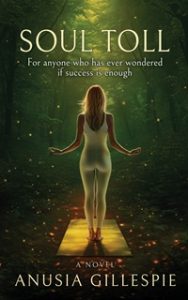 For fans of Eat Pray Love and The Midnight Library, a journey of awakening wrapped in an electrifying adventure.
What if the path you’re on is leading you away from who you’re meant to be?
Soul Toll is a heart-opening and motivational story about waking up, fighting back, and remembering who you were before the world told you who to be.
★ “I was completely immersed—the story is so well written, it felt like a hug for my soul that I didn’t know I needed.”
—Jennifer Riggs, Author of The Ripple Squad (United States)
★ “I am looking forward to the film…”
—Sian O’Neill, Managing Director, Globe Law and Business (United Kingdom)
★ “For anyone feeling stuck, questioning, or searching—this is your invitation to wake up.”
—Anna Lozynski, Fractional General Counsel and Yogi (Australia)
Ember Brooke is sharp, ambitious, and determined to climb the ranks at her prestigious law firm. But beneath the polished surface, something is unraveling—an inner pull toward spiritual awakening she can’t ignore.
A chance encounter with her mother’s old yoga mat pulls Ember into Resonance—a hidden world where she uncovers a disturbing truth: her parents’ relentless pursuit of success wasn’t just ambition, it was engineered.
With an unlikely but unbreakable team by her side, Ember must confront more than the ruthless industry titan NP Dunn to dismantle a powerful empire—she must face the forces inside that keep her tethered to the life she thought she wanted.
As Ember begins her journey of personal transformation, she must decide what success really means and whether she’s willing to trade comfort for freedom.
Set in a vivid, emotionally rich landscape, Soul Toll blends contemporary fantasy with meaning, inviting readers into a story of self-discovery through fiction.
BUY HERE
Category: On Writing
Subscribe
If you enjoyed this article, subscribe to receive more just like it.