The Story Behind The Very Unremarkable Life of Mrs. Etty Bloom by Talya Jankovits
My first publication was a poem about the post-partum female body, specifically my post-partum body. My second publication was an essay exploring the side effects I faced while undergoing fertility treatments. Writing about motherhood, the female body, and infertility has since become synonymous with much of my work because the hard truth is that for many women, the journey towards motherhood can be complex, violent, messy, and full of heartache.
Struggling with infertility is a lonely and isolating experience for most, regardless of class, race, or religion, but as an Orthodox Jew, I felt the added taxing stress of struggling to conceive within an insular community that places great focus and prestige on building a family.
At the time I was undergoing fertility treatments, the dialogue around infertility was still very much a muted one, not just in my own community, but also within the broader world of general women’s health. I hardly saw any representation of infertility in movies, television, or books. And with social media just on the cusp, there was little access to support groups, blogs, or personal essays on infertility. Without meaning to, I found myself writing what I needed to be reading. It was not only cathartic, but necessary. I felt an urgent need to reach the audience I desired to be.
What began as a subconscious exploration of my personal struggles with conception in my writing slowly morphed into an intentional representation and examination of what I learned was a far more common struggle than I originally thought. About 1 in 5 women struggle with infertility, and approximately 20% of pregnancies end in miscarriage. These are staggering numbers. Not only was I not alone, but I was eager to find these women. I tried writing my way towards them.
Over time, as the conversation around infertility expanded, I learned how many other women I knew faced their own struggles to conceive, suffered miscarriages, or discovered they were either unable to conceive or unable to carry to term. The topics of surrogacy, adoption, and fertility treatments became less taboo, both amongst my own observant Jewish community and beyond, but there still remained stigmas, ignorance, and general insensitivity. It felt imperative to write honest representations of motherhood into my works of fiction.
When I set out to write my novel, The Very Unremarkable Life of Mrs. Etty Bloom, which is set in a Hasidic community, I felt compelled to imbue my character with some of my own experiences and those of others. A major theme in this book is the prosaic, and as painful as it is to admit, infertility is very much a part of everyday life for many. And for my main character, Etty, it is also a part of her everyday life.
That Etty is Hasidic and struggling to build a family in the late ‘70s and ‘80s, provides an even greater sense of urgency. She is not only part of a community that places tremendous bearing on the nurturing of a large family, but she is also facing infertility during a time where the general conversation in America about fertility is mostly dormant. Through the character of Etty, I explore the varying components that women face when struggling to conceive or experiencing pregnancy loss, such as the need for emotional support, the damaging effects on various relationships, and the psychological toll on the mind and body.
Etty lacks much-needed emotional support. Her mother is an immigrant suffering from PTSD. She is not only incapable of offering Etty the support she needs but likely suffered her own fertility struggles as Etty is an only child. Additionally, Etty and her husband struggle to find a way to discuss their losses, creating a further divide in their marriage and adding to her emotional turmoil. Etty herself lacks the proper terminology to grasp what she is enduring. It doesn’t cross her mind to seek medical support, as there is no one to guide her. She is ultimately left to shoulder her pain all on her own.
Infusing my novel with the struggles of infertility and the stigmas surrounding infertility and miscarriage enables me to contribute to broadening the conversation about women’s health issues. Despite the immense progress we have made in available resources and honest transparency regarding women’s reproductive health, there is still a need for further destigmatization, particularly in insulated communities. The more we publicly normalize the representation of what so many couples suffer privately, the more we create opportunities to educate, comfort, and foster deeper sensitivity.
Fiction possesses the power to foster empathy and human connection. When we see our own suffering reflected back at us or gain insight into the suffering of others, we close the gap in the divide. Using my writing to offer comfort and illuminate a shared experience of pain is always a prerogative, particularly when writing during a time marked by persistent challenges to women’s autonomy and rights. In this way, a novel about an ordinary Hasidic woman becomes a voice for all women, everywhere — and that is a story worth telling, and a story worth reading.
—
The Very Unremarkable Life of Mrs. Etty Bloom
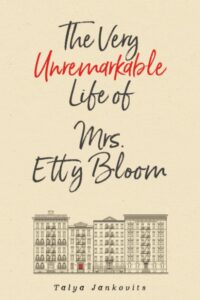 In the insulated Hasidic community of Williamsburg, Brooklyn, tradition and cultural norms are as sacred as religion. Childhood friendships are cultivated to climb social ladders, matchmakers dictate futures, and young girls are primed for marriage and motherhood. So, when Etty Greenberger, a headstrong redhead and the only child of Holocaust survivors, commits one ugly and thoughtless act, she believes she has sabotaged her opportunity to secure a desirable match. Reluctantly, she agrees to marry Benji Bloom, a fishmonger’s son far below her marital aspirations, becoming Mrs. Etty Bloom. With each passing year, Etty grows further from the life she had hoped for, filled with disappointment and delusions of grandeur. As she grapples with loss, grief, and the challenges of motherhood, she also discovers friendship, love, and joy in the most unexpected places. It may take a lifetime, but Etty Bloom finally learns that an unremarkable life can be remarkable after all.
BUY HERE
Talya Jankovits is the author of the novel, The Very Unremarkable Life of Mrs. Etty Bloom (Running Wild Press), and the poetry collection, girl woman wife mother (Kelsay Books), which received First Place in Contemporary Poetry in the 2024 Bookfest Awards.
Her essays, fiction, and poetry have been widely published. She is a multiple Pushcart Prize and Best of the Net nominee.
She holds her MFA in Creative Writing from Antioch University and resides in Chicago with her husband and four daughters. Connect with Talya at talyajankovits.com.
Category: On Writing
Subscribe
If you enjoyed this article, subscribe to receive more just like it.