Three Goals of a Great Story
By Jane Kirkpatrick
Some years ago, at a conference called the Festival of Faith and Writing, I heard Joyce Carol Oates speak about what makes a great story. This multi-published and award-winning author of a National Book Award Book, the Pushcart Prize, a Guggenheim Fellowship and so many more accolades, named three things. A great story should 1) create empathy for the character; 2) It should give voice to voices seldom heard; and 3) it should memorialize. Those story features have guided my career of writing novels based on the lives of actual historical women and especially Across the Crying Sands.
Oates’s number one criteria, having empathy for the character, reminded me of a time I spoke at an international quilt show. I asked how many in the audience were quilters? (I’m not, but I’d written about women who were). About half the crowd raised their hands. I expressed my surprise and asked what drew the others there? One woman said “Well, there have to be people to applaud.” And in a novel, we need someone to applaud. In Across the Crying Sands, I hope readers celebrate the resilience, the inventiveness, the compassion of several characters including the anchor character, Mary Edwards Gerritse, and her husband John, Mary’s parents, and an indigenous woman I named Jewell. All were people who faced challenges, especially Mary, the first woman to deliver mail on the rugged Oregon coast.
I think Oates’s second criteria – giving voice to voices seldom heard – has been the most meaningful for me as a writer. Pioneer women and their indigenous friends are often overlooked in stories. Readers sometimes ask why I don’t write biographies of these women rather than a well-researched novel to highlight those voices. Biographies explore what someone did and when they did it. Fiction allows me to ask why they did what they did, and how they might have felt about it. To help my readers sort out fact from fiction, I include a list of characters with an asterisk marking the ones I’ve made up, calling them “fully imagined characters.” I also add an author’s note where I try to share actions that I found evidence for and those I fictionalized.
Another reason I prefer fiction is that information is sparse and often vague, referring to voices seldom heard. There might be newspaper articles about men establishing a town but not so much about the women in their lives. Women were rarely interviewed and often not even named. Census records might tell me who a woman’s neighbors were but not if they had a relationship with them. An occupation of “at home” might be written after a woman’s name and depending on the time period and the person’s wealth, which might mean someone cooking or cleaning or it could refer to a woman who ran a large household and a business. I look for diaries, letters donated to small county museums and descendants I can interview to get a clearer picture of my character. Often, I discover that family stories of the same event are different. So, I have to fill in the blanks and speculate.
Across the Crying Sands, is another late 1800s pioneer woman’s story. Mary Edward’s Gerritse, as the deliverer of mail, had to judge the tides as in many sections, the beach was the only road. Her inland route took her up and over a mountain that included a narrow trail with an 800 foot drop off to the Pacific should she or one of her horses lose their footing. Those challenges would be enough to make her a character whose story ought to be told. But she was also a wife and mother of four children when she made the decision to take on that mail contract. The couple even hired a nanny, a rather unusual decision for that time period. Discovering that family dynamic added, for me, the importance of exploring how she navigated the waters of marriage, family and cultural mores.
Giving voice to little known characters inspires writers and readers. Mary’s story certainly inspired me, has given me what I refer to as something “for the long haul of living.” The word inspiration means, “the act of breathing in” and these stories of voices seldom heard grant that both in the writing and hopefully in the reading.
As for Ms. Coate’s third criteria, to memorialize, for me that means telling a story worthy of remembering, something to commemorate that may be larger than the individual characters themselves. How communities came together in an isolated coastal area. Discovering how diverse were the roles of women in that era. Mary, for example, cooked for the construction crew that opened the coast to development through a road that had 111 turns in it. Remembering how extended family made a difference, how Anglos and indigenous people were good neighbors, helping each other out of the cellar of sorrows and into an empathic light are tall themes worth memorializing and are a part of this first book in a series.
I hope I’ve written the kind of story that celebrates women, applauds them and remembers their contributions. Only readers will tell.
—
Jane Kirkpatrick is the New York Times bestselling and award-winning author of 41 books most based on the lives of actual historical women in the west. In 2024 she received the Will Rogers Lifetime Achievement Award for her contribution to western literature, has won the national Wrangler, CAROL and WILLA Literary Awards, been short-listed for the Oregon Book Award and the Spur award. She lives with her husband and Cavalier King Charles Spaniel in Oregon. Jkbooks.com; Storysparks.blsky.com; Jane.kirkpatrick.3 – Instagram Facebook/authorjanekirkpatrick
ACROSS THE CRYING SANDS
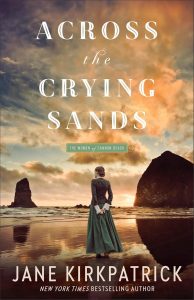 A Tale of Uncharted Adventure and Discovery Inspired by a True Story
In 1888 Mary Edwards Gerritse is a witty and confident young woman who spends as much time as possible outdoors on the rugged Oregon coast where she and her husband, John, have settled. The two are a formidable pair who are working hard to prove their homesteading claim and build a family. But as Mary faces struggles of young motherhood and questions about her family of origin, she realizes that life is far from the adventure she imagined it would be.
After losing the baby she’s carrying, grief threatens Mary, but she finds an unconventional way to bring joy back into her life–by taking over a treacherous postal route. As Mary becomes the first female mail carrier to traverse the cliff-hugging mountain trails and remote Crying Sands Beach, with its changing tides and sudden squalls, she recaptures the spark she lost and discovers that a life without risk is no life at all.
“Jane Kirkpatrick’s writing evokes a powerful sense of the challenges and strengths of women who settled the West.”–SANDRA DALLAS, New York Times bestselling author
In this inspirational historical Christian novel, a pioneer female mail carrier lives a life of resilience, including grappling with grief and the loss of a child and facing the challenges of frontier life.
BUY HERE
Category: Contemporary Women Writers
Subscribe
If you enjoyed this article, subscribe to receive more just like it.