What Virginia Woolf Taught Me
In my mid-century memoir, Cold War in a Hot Kitchen, I relate that when my mother went back to university to study for a master’s degree, my father refused to let her talk about it. He was embarrassed, he said. It was pretentious for his wife to pursue a graduate degree, when so many of his colleagues’ wives had no degree at all. My mother wrote her thesis on a makeshift desk in the family room. When company came, she hastily covered the offending typewriter and books with a tablecloth. While our house was big enough when her children had grown and left, my mother never felt she had the right to take “a room of her own” in which to write.
The right to write. That’s what Virginia Woolf taught us.
More relevant to our own time is that she meant that women had the right to earn money by their writing. To become a professional, they needed training, time, and a place to work.
I recently attended a weekend-long seminar in England on Virginia Woolf. Because 2025 is the centenary of one of her seminal books, Mrs Dalloway, she is being celebrated in many literary circles this year. In July I participated in a continuing education program at the University of Cambridge, where we studied The Waves, Woolf’s most stylistically challenging book. But Mrs Dalloway remains my favorite of her books. The story has two protagonists; Clarissa Dalloway, a socialite whose easy charm overlays an interior seething with regret, irritation, and jealousy, and Septimus Smith, a veteran of World War I. His “shell-shock” (now known as PTSD) is being treated by an insensitive doctor who cannot grasp what his patient is experiencing.
It is easy to see some autobiographical elements in these two characters. Woolf herself was an intensely social person, witty, beautiful, and surrounded by interesting, notable people all her life. She was also prone to bouts of paralyzing mental illness for which the only treatment available at the time, rest and removal from society, did little to alleviate.
Intensely sensitive to what her mind was telling her, Woolf pioneered the writing down of the inner voice that jabbers at us all day long. It’s not always a socially acceptable voice, and when used authorially, it creates a richer, deeper character on the page. It has now become a standard method of writing “voice.” I wondered how Woolf came to this method of writing. Reading several biographies of her in preparation for the course, I learned that she and her sister Vanessa had never gone to school. They were denied the education that was the birthright of their brothers. Virginia educated herself by reading through her father’s immense library. She’d read all of Shakespeare by the age of eleven. She’d never had a teacher to reprimand her when she wrote stories that were unconventional in style.
She wrote A Room of One’s Own to highlight how society hampers women. In her youth women could not vote and had to marry to be socially accepted. Virginia Stephen, as she was, became exceptionally lucky when she married Leonard Woolf, who nurtured her and her writing. Not for her was the trad-wife role. Recognizing that she needed an activity that required concentration yet was not cerebral after her mornings of writing, Leonard bought a printing press and type blocks and founded the Hogarth Press. The press published Virginia’s works. She was the original self-publisher—which should encourage all writers today!
Virginia and Leonard Woolf had the contacts that allowed them to attract writers who would become famous, like T.S. Eliot, John Maynard Keynes and other 20th century luminaries. The Hogarth Press became famous in its own right as a publisher of highly original work. Most writers today struggle to cut through the noise of the four million books published annually in the United States. If trying to get an agent, they must pitch “comps” i.e. similarities of their own work to that of already known writers. Yet by taking the business of publishing into one’s own hands, some writers are successful. To follow a dream, to write what one needed to write and not to copy others – and be successful even if the writing style is ground-breaking and challenging – is one lesson of A Room of One’s Own.
We women writers owe Virginia Woolf a debt.
—
Margaret Ann Spence writes about women, the choices they make, and what happens next. She is the author of two novels, Lipstick on the Strawberry, which won the Romantic Elements Category in the First Coast Romance Writers 2015 Beacon Contest, and Joyous Lies, a finalist for the 2022 Somerset Award for Literary and Contemporary Fiction.
Born and raised in Melbourne Australia, Margaret has lived on both coasts of the United States, and now makes her home in Phoenix, Arizona. Her memoir of mid-century Melbourne, Cold War in a Hot Kitchen, was published in September 2024.
COLD WAR IN A HOT KITCHEN
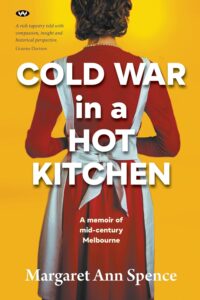 The 1950s. Boring?
Hardly.
An influx of European refugees, stirrings of feminism, and the threat of a third world war were remaking Australia. As the Cold War chilled, inside a Melbourne house a young girl was caught in the crossfire of domestic conflict amid the clashing political and social values of her autocratic grandmother, her self-denying mother, and her glamorous aunt; three women who presented very different models of womanhood.
BUY HERE
Category: On Writing
Subscribe
If you enjoyed this article, subscribe to receive more just like it.