Whatever Happened To Lori Lovely? by Sarah McCoy: Excerpt
WHATEVER HAPPENED TO LORI LOVELY?
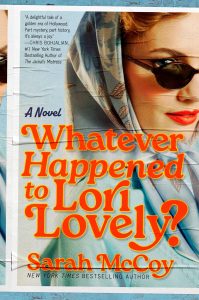 From New York Times bestselling author Sarah McCoy—a spellbinding novel based on a true story: a beautiful young movie star of Hollywood’s Golden Age gives up her bright career to become a nun.
In 1969, twenty-three-year-old starlet Lori Lovely, the apple of Hollywood’s eye, shocks the world by ditching a promising film career to take vows of poverty, chastity, and obedience as a Benedictine nun. Gossip columnists and scandal sheets can’t get enough of the story. Why would such a beautiful girl take the veil? Was she hiding from someone? Did it have anything to do with the tragic death of her costar, heartthrob singer Lucas Wesley?
In 1990, Lu Tibbott is under the gun to complete her senior thesis in modern American history. Instead of spending weeks in dusty archives, Lu decides to dig into a true twentieth-century mystery and write about her aunt Lori, now the Mother Abbess at a cloistered convent in rural New England. Biographers, bloggers, and media types have long speculated about her aunt Lori’s sudden departure from Hollywood. Mother Lori, however, has refused all requests for interviews—until Lu arrives at the abbey with a tape recorder in hand. To her delight, Mother Lori announces she’s finally ready to talk…but only if Lu is truly ready to listen.
Lu is shocked to discover that the story of Lori Lovely’s rise in Hollywood was far more tumultuous than she’d ever expected, a fairy tale twisting with ambition, unforeseen alliances, forbidden love, and secrets. What began as a history thesis now threatens to upend all their lives with its unexpected truths, especially as the media gets wind of Lu’s project and begins to ask…
Whatever happened to Lori Lovely?
EXCERPT
The Abbey, Connecticut
October 1990
“So where do you want to begin?” she asks.
“Wherever you want?” I reply.
“No,” she says, and it isn’t gentle. “You’re the one writing this, Lu.”
My hand flinches and leaves a pencil dash across the page. “What do you mean? This is about you, Aunt Lori.”
“Is it?”
She turns to face me. Originally Lucille Lorianne Hickey, formerly Lori Lovely, christened Sister Jude by the Queen of Praise Benedictine Abbey, and now Mother Lori by choice. My aunt is an icon like no other. The gold cross pendant around her neck swings. The veil of her wimple frames her pale face, concentrating all color into her eyes. Blazing blue, like the sky fresh after a storm. Crystalline. I can’t look away and neither could audiences for a time.
I had a crush on her when I was young. Torn between wanting to be her and wanting to be so close that my body and bones melted into hers. It’s hard for anyone who hasn’t met Aunt Lori in person to understand. I wish more people could see the real her.
My eyes are blue, too. That’s about where our physical similarities end. I didn’t inherit the golden hair, the cherubic bone structure, or starlike twinkle. I’m all angles and dark curls, presumably from my dad’s Welsh side. But I get a kick out of seeing that blue streak of DNA reflected in film footage. I’m a little vain about our eyes, admittedly.
They named me Lucille-Marie because I was born eight days before Aunt Lori’s birthday. I’ll be honest, it was hard growing up when your first, middle, and last names already have a face and history. I was given the nickname Lulu to distinguish me, but by elementary school, Lulu became the popular playground satire: Lulu is cuckoo; Lulu does voodoo; Lulu takes a poopoo; Screw you, Lulu . . . Kids can be savage, and once a stigma is attached, it’s hard to change public opinion.
In an effort to renew myself the summer before I started high school, I locked myself in the bathroom with a magazine photo of Pat Benatar and my mom’s sewing scissors. I chopped my long brown hair into a pixie cut. Each time the blades came together, there was a liberating resistance and release. When I came to the dinner table, my parents were shocked, naturally. I told them I wanted to go by just Lu from then on. Dad passed Mom a look. She teared up and excused herself to the kitchen.
“What made you decide this?” Dad asked.
“I don’t know,” I said, running a hand up my bare neck. “It just felt right.”
He nodded silently and forked his slice of meatloaf.
Mom returned with a bottle of ketchup. “I forgot this.”
And on we went.
In all my high school photos, it’s hard to tell if I’m a girl or a boy. Looking back, I wonder if that was my problem. I wasn’t sure who I was or who I wanted to be. I can’t say I’ve figured it out yet.
I’m in my fifth year at Mount Salem College and still don’t know what I want to do with my life. I sampled a few majors (English Literature, Forensic Science, Journalism) before landing on History, which even now I am floundering in. Nothing’s quite fit. My silent fear: the problem is me. I don’t fit . . . anywhere. Never has it been so official as printed on a college transcript. A laundry list of unfulfilled requirements, unfulfilled hopes.
I changed my major this last time after taking Professor Proctor’s course “Controversial Music History: 1900 to the Present,” wherein he evangelized on the untold story behind the public life of American musician Billy Tipton, born Dorothy. It flipped history on its head.
Professor Proctor was an old soul with furry white eyebrows that accented his round spectacles and made his eyes look theatrically animated. He showed outward compassion in ways the others did not, like a grandpa with a butterscotch disc in his breast pocket. I never knew either of my grandpas. Grandpa Tibbott died before I was born and Grandpa Hickey when I was four. Professor Proctor is what I imagine of grandpas.
So, when he called me to a meeting before the department board, I knew I must be in serious trouble.
“Miss Tibbott, I don’t want to see all your hard work come to naught.”
It warmed me—the naught. It was so historical, so Professor Proctor.
“My colleagues have discussed your academic record. Unfortunately, no matter how much potential we see in you, the board is in unanimous agreement that we cannot graduate a student who has not completed the final opus of her academic journey.”
He took off his glasses to wipe the moisture away. His face was flush. It pained him to say it and made me adjust uncomfortably in my chair. The Shaker-style spindles grated my back.
“I’ve spoken to the board on your behalf and they’ve agreed to give you one last chance to complete your thesis. You have enough credits to graduate, so your current courses will be audited and listed as Thesis Colloquium, for which I will serve as your advisor.”
The head of the department, Dr. Gibbons, gave the kind of overly emphatic exhale that a livid parent gives a child or an ill-mannered dog.
“Professor Proctor has vouched for your scholastic capacity. As a colleague, we are honoring his recommendation,” said Dr. Gibbons. “Thesis or no, you will not be admitted to Mount Salem College for subsequent semesters.”
I got the point. They wanted me to fish or cut bait. The problem was, like my major, I’d started and stopped writing various thesis topics but couldn’t land on one interesting enough to sustain a dissertation. The longest essay I’d written was ten pages, double-spaced. And truth be told, I’d increased the margins before printing to hit the length requirement.
The skin behind my ears went hot. An agonizing itch crept dewy down my neck. But I refused to let them see me squirm.
“Are we settled, then?” Dr. Gibbons checked his watch.
It was nearing noon, and their kind held a strict lunchtime dictum.
I nodded. “Write my thesis. Graduate. Got it.”
“Good. That will be all,” said Dr. Gibbons.
I was dismissed. Professor Proctor accompanied me down the hall. The History Building’s steam radiators gave off musty gurgles. He put a consoling hand on my shoulder.
“Let’s discuss your thesis. I believe the issue you’ve experienced with your previous subjects is that they have no personal affiliation. They lack . . . passion. Don’t think of history as a list of names, dates, and facts. It’s not a static entity. Think of it as a living thing—a person you want to sit down beside to hear his or her story so as to better understand the happenings.”
Once he reframed it as a person, the task changed. Immediately, she came to mind.
“My aunt Lori Lovely,” I said. “I wrote that paper for you last semester about her.”
It hadn’t been a profound piece, a one-thousand-word essay. The whole of it was me spouting off about being the niece of a bygone movie star. But Professor Proctor had handed it back saying, “Well done, Miss Tibbott! Utterly riveting. I could read an entire book about Lori Lovely. I always wondered whatever happened to her.”
I got the sense that he was asking for more information, but I hadn’tany to share. She is my aunt and an enigma. I’ve always been drawn to her, but she has secrets. A known fundamental of religion is keeping and sanctifying secrets. So, I can’t be sure if the mystery is in her occupation, her person, her relationship with me, or all three. For years, I wanted to ask certain questions. Questions I sensed might upset my mom and dad. Questions that under other circumstances might be uncomfortable for a niece and her aunt to discuss. But this—my thesis!—is a professional construct. At least on paper. I needed to write this. Everyone would agree. I have to graduate. And if I finally got answers to questions I’ve been afraid to ask, well, God works in mysterious ways. That’s what Aunt Lori tells me, at least.
For Professor Proctor’s sake, I pitched it differently: “I’m going to write about the 1960s musicals and the film industry . . .”
His brow had furrowed in a ponder.
“But really, it’s about Aunt Lori. Her untold story. The stuff nobody knows. Why she became a cloistered nun, and all that.”
“Splendid. I think that will go over well. Final manuscripts are due December twelfth and not a day later. Don’t let me down, Miss Tibbott!”
He’d patted my shoulder and walked away. The click of his shiny loafers and smell of Old Spice decrescendoed.
My mind had raced. It was the beginning of October. The clock was ticking.
That’s how I ended up driving over six hundred miles from North Carolina to Connecticut with every radio tower playing Janet Jackson’s “Escapade” and Paula Abdul’s “Straight Up” on maddening repeat. Somewhere in Virginia, I turned it off. Ten hours on I-95 was a good time to figure things out.
First off, I needed to get my story straight. If I rode in on a wobbly horse, Aunt Lori would see my Trojan aim immediately. I had to arrive brandishing a thesis statement with philosophical heft. I needed that for Professor Proctor, as well. Two birds, one stone.
Here’s the catch: I don’t particularly trust history. It lionizes model citizens, but it seems to me the only ones that are ever worth their salt are the men and women who break the rules. Meaning, a person can make all the right choices by civilization’s standards and still end up all wrong. History is a tangled web of half-truths we tell ourselves. The trick is to figure out which half are truer than the other. That is my goal for Aunt Lori.
At a rest stop in New Jersey, I got a Wendy’s Frosty and scribbled on the brown napkin:
My Aunt Lori was one of the most famous movie stars of the 1960s. She became a Benedictine nun. Whatever happened to Lori Lovely? Herein, I shall attempt to provide the details of her story for historical record and to finally unveil her journey from sex symbol to saint.
Sex symbol to saint. Alliteration. Yeah, that was good.
From Whatever Happened to Lori Lovely by Sarah McCoy. Copyright © 2025 by Sarah McCoy. Reprinted by permission of William Morrow, an imprint of HarperCollins Publishers.
BUY HERE
Category: Contemporary Women Writers
Subscribe
If you enjoyed this article, subscribe to receive more just like it.