Where it Comes From By Pam Troy
It began over a decade ago with a woman’s face. I knew her name immediately — “Gwennoelle Duday.” Also known as “the Witch Duday,” or, with lowered voices, “Herself.”
A stout woman in her thirties, with a crown of blond braids pinned up beneath the wide-brimmed palmetto hat that shaded her stern blue eyes, her formidable double-chin. She wore the clothes of a respectable working woman from the eighteen-eighties, a clean cotton dress with a long skirt that stopped just above the ankles and a light shawl loosely draped over her shoulders.
Over one strong arm she carried a covered basket which held a worn deck of marked playing cards, a glass vial tied with red ribbon, and a cup of dice. Gwennoelle Duday, teller of fortunes, rebuker of ghosts, and a newcomer unused to the tropics, strode briskly in spite of a blazing blue sky and damp, suffocating heat. Her scuffed, low-heeled boots crunched on the gravel of a road lined on both sides by thick green brush buzzing, hissing, and croaking with small biters and stingers.
At that moment I had no idea I was writing a novel. I was just telling myself a story on my way to work in downtown San Francisco. Hours later, when I began my walk home, I knew not only the Duday family, but their neighbors and the place they had recently made their home, the wicked, fantastic Isle of Touperdu.
For the next few years, I entertained myself by continuing the story of the supernaturally “talented” Dudays and their fellow immigrants, the wealthy, “untalented” Roselyns and Ballous. Born and bred islanders included the conniving Mayoress Ellen Reckoner, the formidable nurse/midwife Augustine “Mankiller” Baldridge, and the piratical Captain Lyle Fry.
This imaginary world grew from memories of a childhood in Louisiana and the books I’d read there. When I was six, I discovered the Life Treasury of American Folklore, brilliantly (sometimes gorily) illustrated by James Lewicki.
In my teens I read Gumbo-Ya-Ya, Lyle Saxon’s jangling, gritty compendium of Louisiana tales, and then there was Harnett Kane’s irreverent Plantation Parade, which my high school history teacher recommended for its information on early sugar cane production. (It was, indeed, helpful for my school report, but I devoured the rest of the book for its gossip.)
For several years after the morning I met Gwennoelle Duday, I stirred this gumbo of memory and fable. Every now and then, when I really should have been doing something else, I would write some of it down.
One day, I looked over the saga I’d told myself and realized I had not one novel, but several. Something had to be done about it.
That’s when the real work began on The Chronicles of Touperdu. Turning a daydream into a novel series requires filling in sharper details than what legend offers. Fantasy is all very well, but to be believable it must be bolstered by realism. I needed to explore a foreign land — the nineteenth century. Each fact about Touperdu raised questions that had to be answered.
The island’s economy was based on cotton and sugar cane. How dependent were those crops on forced labor? How was the massive workforce they needed obtained and then controlled on an island?
A genteel dining alternative to rough tavern fare had opened on Touperdu – The Rose, seen as a crowning jewel of the island’s entry into the modern world of eighteen-eighty. Were restaurants at that time run the way restaurants are today? What kinds of ingredients were available in the Caribbean?
Why were so many immigrants coming to the island? What were the hazards the Dudays faced in moving from Central France to a tropical climate?
I read histories. I read about immigrant exploitation, debt slavery and scrip, about how and when restaurants as we know them were invented. I read about New Orleans, about the post-reconstruction south, about Yellow Fever and about the economic upheavals in the United States and Europe after the Civil War. I read about forgotten tragedies and atrocities, the Last Island hurricane and the New Orleans Mechanics’ Institute Massacre. The more I read, the more the island and its people took shape.
So did the fantastic elements of my story. There is magic on Touperdu, but there are no “chosen ones”, and no royalty. When Gwennoelle Duday wields her “talent” as a weapon, winds do not blow and thunder does not crash. A busy woman has no time for such nonsense. Gwennoelle’s sorcery is, like Gwennoelle herself, effective, unforgiving, and ruthlessly practical.
Though fiction summed up by “and the moral is…” has never been my strong suit, I have a viewpoint, like any writer. The Newcomers is not just about the supernatural and the adventure of a new land, but about the way communities give with one hand while taking with the other.
There are villains on Touperdu. Their evil deeds come, not from the pits of Hell, but from the affluence and entitlement that make compliance more important than conscience. There are heroes on Touperdu, but readers will find no role models – only common decency and, occasionally, courage.
Which are, unlike casting spells or speaking to the dead, powers available to all human beings if we just have the will to use them.
—
Pam Troy worked for twenty years in the Events Department at San Francisco’s Mechanics’ Institute, one of the oldest libraries on the West Coast. Though she has resided in San Francisco for most of her adult life, she was born and raised in Louisiana, and her fascination with that state’s history, culture and folklore went into creating the world of Touperdu. Her short stories have appeared in magazines and anthologies like Space and Time, Crimson Fog, State of Horror: Louisiana, and Another Dimension. She lives in San Francisco with her husband, a cat, and far too many books.
The Newcomers: The Chronicles of Touperdu, Book I
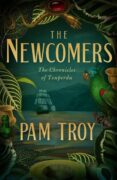 It is 1880, and immigrants are flocking to a new refuge from the economic and racial turmoil of the late nineteenth century.
For New Orleans chef Amadeo Roselyn, the Isle of Touperdu is where he can open his own restaurant and raise his daughters as educated, marriageable ladies in a place free of the violence roiling the post-Reconstruction era south. For Gwennoelle Duday, the matriarch of a rackety family of witches from the French village of Fourche, it is where the Dudays can act freely, unfettered by other people of “talent” and any foolish talk of rules and higher law.
But the night before they disembark, a question troubles both Amadeo in first class, and Madame Duday in steerage. It is one that will haunt them for years after they step onto the island — is the promise of Touperdu a lie?
The Newcomers is the first novel in a series set on the fictional island of Touperdu, where the lines blur between superstition and magic, legend and history, promises and betrayal. Two immigrant families confront the question all outsiders face when they enter a new world. What can you do — and what will you give up — to truly belong?
BUY HERE
Category: How To and Tips
Subscribe
If you enjoyed this article, subscribe to receive more just like it.