Writing Comedy Is No Joke
By Sue Clark
My name is Sue Clark and I suffer from CWS. That’s comedy writing syndrome. Why do I have this compulsion to write comedy? You might think, because it’s a pleasant way to spend my day. It’s fun. It’s easy. Allow me to enlighten you.
Don’t get me wrong, writing humour can be all of those positive things… when the writing is going well. True if you were to listen at my office door – promise me you’ll never do that! – occasionally you might catch me having a giggle at something I’ve written. But honestly, you’re much more likely to hear mild bad language, groans of anguish or cries of frustration. Because writing comedy is hard.
Sorry to disillusion you, but funny lines and amusing set-pieces do not stream effortlessly from the writer’s brain to the keyboard. Not this writer’s anyway. I do not spend my working days holding in my splitting sides, chortle muscles permanently doing overtime. On rare occasions the comedy god will smile and the witty words will flow. More often than not, that amusing phrase or rib-tickling scene is the result of much forehead clutching, a generous sprinkling of “flipping hecks” and many rewrites.
All writing is much harder work than might be apparent to the outsider. Writing funny stuff is no exception. Yet, like children’s authors, we humorous writers have for too long had to put up with the common misconception that what we do is somehow less demanding, just having a laugh, hardly work at all. But think about it. On top of devising a devilish plot, breathing life into a cast of colourful characters, creating a clever twist or two, and setting the whole kaboosh in a well-imagined world, we have given ourselves the additional challenge of making our readers laugh. Far from being easier than ‘serious’ writing, I would argue, it is harder.
But, as I said, I have no choice in the matter. The urge to write novels is not a gift or a talent. It’s an affliction. And writing funny fiction is a particularly severe form, which I contracted early on in my writing career. How? Like many people these days, I blame the BBC.
Back in the mists of time when I was immature and foolish – as opposed to mature and foolish, as I am now – I came up with the crazy notion that I could make a living by writing jokes. Together with a good friend and fellow writer Lesley Bootiman – because you need two people to write comedy scripts: one to sit at the keyboard, the other to stare out of the window – I wheedled my way into the BBC Writers Room in Broadcasting House. From the moment I stepped into that scruffy room, I was hooked.
We ended up contributing sketches to radio and TV light entertainment shows. It was fun while it lasted but didn’t exactly provide us with a secure living. So, reluctantly, we turned to more grown-up professions instead. But my urge to make people laugh never went away.
Fast forward some decades and I found myself with time on my hands. Why not, I thought, scratch that comedy itch again, this time giving myself the creative space of a novel? It took longer than I anticipated and was more difficult than I could have ever imagined, but I got there.
The journey hasn’t been straightforward. Novel writing is very different from scriptwriting. Though I’ve been a scribbler all my working life, I had to acquire new techniques. Mainly, you may be surprised to hear, I had to dial down on the humour.
Comedy scripts are stuffed full of gags. A TV sitcom, for example, can average three jokes a minute. That adds up to more than 80 per 28-minute show. Imagine that sort of gag-pace in a 300-page novel? The reader would be exhausted, and the book probably heading for their DNR pile.
Novels give the writer the luxury of being able to dig deeper, vary the pace, allow yourself to pause and look around, before pressing on with the narrative. And the best comedy fiction, I believe, is touched with pathos, a delicate balance between laughter and tears, a bitter-sweet quality that is ruined if too many gags are forced in.
Irrelevant jokes, no matter how funny, cause characters to act, well, uncharacteristically, and plots to veer off course. Though it may be fun to write, I quickly learned, if a line doesn’t illuminate a character, set the mood, or help the story bowl merrily along, it should not make it past the first draft. Even in comedy, the characters have to convince, the story has to make sense and feel real – albeit within the bounds of its own, hopefully hilarious, world. Kill your darlings, even the funny ones!
I became more discerning. The outcome is I’ve now had two humorous fictions published: A Novel Solution (‘When your life becomes fiction’) and Note to Boy (‘She wants her celebrity life back. He just wants a life’). And I’m not done yet. Currently, I’m putting the finishing touches to novel number three. But Mostly Mabel is set in a decaying country house where nothing and nobody works, except the cook/housekeeper Mabel, a powerhouse in a pinny. Mabel will be making her appearance later in 2026. Keep an eye out for her.
So here I am, back where I belong, still obsessed with making people laugh, still trying to make a living from comedy. And, despite the hard work, still having fun!
sueclarkauthor2020
@SueClarkAuthor
srlpublishing.co.uk/product/a-novel-solution-sue-clark
srlpublishing.co.uk/product/note-to-boy-sue-clark
NOTE TO BOY
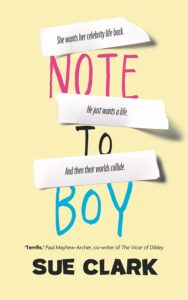 Eloise is an erratic, faded fashionista. Bradley is a glum but wily teenager. Together, they make an unlikely team.
In need of help to write her racy 1960s memoirs, the former ‘shock frock’ fashion guru tolerates his common ways. Unable to remember his name, she calls him Boy. Desperate to escape a brutal home life, he puts up with her bossiness and confusing notes.
Both guard secrets. How did she lose her fame and fortune? What’s he scheming – beyond getting his hands on her bank card? And just what’s hidden in that mysterious locked room?
BUY HERE
Category: How To and Tips
Subscribe
If you enjoyed this article, subscribe to receive more just like it.