An Old Man’s Darling by Deborah K. Shepherd: Excerpt
KIRKUS REVIEWS calls Deborah K. Shepherd’s new memoir, An Old Man’s Darling, “…unflinchingly honest…a thoughtful and multidimensional examination of love, power, and self that doesn’t shy away from asking difficult questions.”
We’re delighted to feature this excerpt!
AN OLD MAN’S DARLING
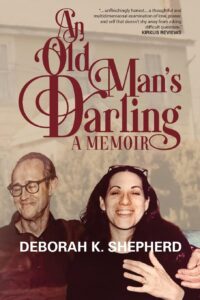 What could possibly go right when a 21-year-old Jewish/agnostic erstwhile hippie chick college dropout and a 55-year-old staid, unhappily married businessman/Episcopal priest fall in love? Plenty, it turns out. An Old Man’s Darling is the story of a love affair, parenthood, and a marriage; a 20-year chronicle of the unlikeliest of relationships.
Yes, there is a power differential (and everything that goes along with that) AND the pair love each other truly, deeply, and yes, a little madly, too. This is a story for anyone who’s ever observed mismatched lovers and wondered what in the world they could possibly see in one another; for anyone who’s ever had a crush on an older man (or woman) and wondered how the fantasy might turn out; and for anyone who understands that sometimes love is just crazy, and that there’s no one-size-fits-all explanation of what attracts one human being to another.
With today’s perspective, and the benefits of both age and hindsight, Shepherd revisits her past, asking tough questions, of herself and about romantic love, religious roots, judgement from others, and feminism, in what becomes a powerful, engrossing and unforgettable read about an improbable love.
PROLOGUE
If I could go back, it wouldn’t be to the beginning—although I bet you would—that lust-fueled, late-in-your-life, last chance, risk everything shocker of a love affair that started our story.
No, I’m more drawn to the middle—the get-the-kids-out-of-bed-in-the-morning; throw a load of laundry in the washer before work; walk the dog; have dinner on the table at six; occasionally glorious—but mostly quite ordinary—days that now seem sacred.
Those were our best times. I wish I’d known it then.
#
Hillsdale, New York, 1982
The houselights have dimmed, and a single spotlight comes up to illuminate an empty stool, stage left, in front of the proscenium. A man ambles over to the stool but doesn’t sit, more like perches on the edge. He looks to be about seventy, is tall and lean, and his face has the time-chiseled features of someone who’s never carried an ounce of fat on his bones. He has a pipe clenched in his teeth, but it isn’t lit—fire regulations. He’s wearing a fedora, pushed back on his head, and an unfashionably skinny tie under his vest—way before this throw-back look was discovered by hipsters. His costume comes from his own closet.
He waits to speak until latecomers have been seated and the audience settles down, then removes the pipe from his mouth and puts it in his pocket.
“This play is called ‘Our Town.’ It was written by Thornton Wilder…The name of the town is Grover’s Corners, New Hampshire—just across the Massachusetts line…”
His voice is sonorous but soothing and reaches to the back of the old Masonic Hall in this pastoral town in New York’s Hudson Valley, also just across the Massachusetts line. There’s a collective sigh when the man begins to speak, and audience members settle back into their hard wooden seats as his words transform a bare stage into a sleepy little New England burg, circa 1901:
“The sky is beginning to show some streaks of light over in the East there…Along here’s a row of stores. Hitching posts and horse blocks in front of them. First automobile’s going to come along in about five years…This is our doctor’s house, Doc Gibbs’…This is Mrs. Gibbs’ garden. Corn…peas…beans…hollyhocks …heliotrope…”
I’m waiting backstage for my imminent entrance as Mrs. Webb, the wife of the town’s newspaper editor, and when the Stage Manager’s voice rises then falls on the word “heliotrope,” I smile. I don’t know why, but it sounds almost tender. I find out later it’s Greek for “a plant which turns its flowers toward the sun” and signifies eternal love and devotion. I imagine the audience smiling, too, as they warm to their guide through this familiar territory. They know they’ll be in good hands for the next two hours.
I’ve been in those good hands for the past dozen years or so. The man is my husband, the father of my two children, and I’m filled with such love and pride—but also trepidation—as he begins to speak. We’ve lived in this community for a little over a year—in an even smaller town, just up the road from the Masonic Hall—and I’ve worked at the local paper for most of that time.
People recognize me: They’ve seen me at school board meetings; I take their pictures when they’re celebrating their fiftieth anniversaries or the opening of deer season as they pose with their eviscerated six-point bucks; I write a monthly column about the ups and downs of smalltown living. But most of them don’t know Bill as my husband, because he spends so much of his time engaged in renovating our 150-year-old house and most of his interactions are with the guys at the lumberyard. We tend to keep to ourselves a lot. I’m not sure if this is because it’s hard to find couple friends with interests in common or because so much of our early relationship had to be carried out in secret. So this evening is, in a way, Bill’s public debut, not just as an actor, but as my spouse—our coming out party.
He is, indeed, nearing seventy—he doesn’t need any stage make-up to turn him older. I’m in my mid-thirties, and our children are five and eight. When we’re all onstage together, and people we’ve never met check their programs and see we all have the same last name, the cat will be out of the bag.
Which means, I know, many of our fellow townspeople—after first wondering if Bill is my father—will put two and two together and come up with something close to thirty-four, which is the age difference between Bill and me.
The four of us are taking part in this community theater production at my urging: something the family can do together that doesn’t involve moving a metal thimble or Scottie dog around a board and collecting $200 when we pass Go. I’m playing the mother of Emily Webb, whose courtship, wedding, and untimely demise are depicted in three acts. Our son plays a newsboy and has worked hard at memorizing his lines, harder, in fact, than he’s ever labored on his spelling words or math assignments. The play’s director has cast our five-year-old daughter in a non-speaking role as one of the residents of the cemetery in Act Three. Having her play a dead child gives me pause, but our little girl is thrilled to be an actress and sits very, very still on stage.
Our Town’s third act takes place twelve years after the first—in 1913—which is, coincidently, the year of my husband’s birth.
PREORDER HERE
Shepherd’s first novel, So Happy Together, was published in 2021 when she was 74. Her essays have appeared in Oldster Magazine; Fauxmoir; Motherwell Magazine; Herstry; Eat. Darling, Eat; Persimmon Tree, and more, and her Covid-themed essay was a winner in the Center for Interfaith Relations 2020 Sacred Essay Contest. A retired social worker, she spent much of her career focused on the prevention of domestic violence and sexual assault and the provision of services to survivors. The mother of two and grandmother of two, Deborah lives in Maine with one husband and one sweet, jaunty rescue dog. You can find her at deborahshepherdwrites.com.
Category: On Writing
Subscribe
If you enjoyed this article, subscribe to receive more just like it.