How ILLEGITIMATE Took Seven Revisions and Ten Years to get Published by Maddie Lock
I didn’t start out to write a memoir.
It was in a small café in Bavaria that my German aunt lifted a glass of wine to her lips and casually stated that she had found her father; that our grandfather, who we thought was her father was not. She was, in fact, a child created for Hitler’s vision of the perfect Aryan race, through a Nazi eugenics program that encouraged mating between blonde-haired, blue-eyed and pure-blooded men and women, married or not. And yes, she found her real father but he died before she had a chance to meet him. That revelatory evening, she felt she had said too much and quickly left the café, leaving us shocked and confused. It would be three years before she agreed to open up.
As I pondered about all the genetics we would never know, I resolved it was time to find my own biological father. My German mother had refused marriage, handed me to my grandmother to raise, and left the country in a dance troupe to travel the world and escape post-war Germany. She also cut my father out of my life with a court-order. Now, at the age of sixty, I decided it was time to find him, although there was an excellent chance he had died.
And so began a writing journey that would span years of traveling back and forth across the pond several times a year, each time for a month or more. My cousin Michael had a spare bedroom that was large enough to set up a workstation, and I spent hours every day writing memories, trying to come up with an outline, and researching Naziism and Lebensborn. Michael and I planned to spend time with Sieglinde as she told us her story.
I had also shared with Michael that I now wanted to find my father, and he found an address in a town close to Frankfurt. We pulled up to a large apartment building one afternoon and rang my father’s doorbell. I introduced myself.
What began as research into the Lebensborn program and the Nazi propaganda machine, turned into a braided story about the need for my aunt and I to know our fathers so that we could ultimately know ourselves. Suddenly I had a memoir. I began taking online classes through CNF (Creative Nonfiction) and reading excellent and diverse memoirs: Stop-Time by Frank Conroy, Running in the Family by Michael Ondaatje, Don’t Let’s Go to the Dogs Tonight by Alexandra Fuller.
On my trips, I sat down at night and jotted notes: any conversations, new revelations, my thoughts about what I had learned and what was still unknown. The biggest challenge was that my knowledge of the German language was limited, so I began studying German. It helped that my cousins could speak English, and were able to confirm my notes.
After much trial and error, I decided to write about my discoveries chronologically. I added chapters as needed to reflect on an event that had happened. For example, after my father told me about how he and my mother had met (at the printing shop where he worked and she came in looking for part-time work) and how their relationship had been one of adventure and fun (they took trips on his motorcycle) and I saw photos of my beautiful and happy young mother, I pondered about what might have happened when she found herself pregnant. I tried to put myself into that time period to understand the hardships she had gone through as the eldest sibling in her family, and the responsibilities she wanted to leave behind. Her reasons for giving me to my grandmother to raise while she took off traveling the world as a dancer.
I also found that certain information I had always believed as true ended up false, and shared these facts as I discovered them. I split the book into three parts: Foundation, which chronicled my birth and life with Oma and being reclaimed by my mother; Discovery, which revealed finding my father and getting to know him and his family at the same time I learned Sieglinde’s story; and Acceptance, which allowed me to tie up loose ends and come to conclusions and forgiveness. As the reader follows along, it becomes an immersive experience.
After working with an insightful teacher and editor by the name of Kase Johnstun, we got the story tightened up, and I began the query process. I received a few “wish I could accept this—it deserves to be out there”—but the overall feed-back was that the story did not have enough universal appeal. “Unique” became a bad word in my mind. It was also the aftermath of COVID, and it seemed that anyone who had ever wanted to write had done so. Agents stopped taking submissions. Many who were, didn’t respond.
I began submitting to indie publishers. After another year or so of rejections I became frustrated again and stopped pitching my book while still submitting essays to anthologies and online journals. I kept casually researching publishers and one day ran across Vine Leaves Press. I decided they would be my “Hail Mary pass.” I did one last read through and sent the manuscript off.
In April of 2024 I received an acceptance and signed a contract.
Maddie Lock bio:
German born, Maddie Lock fell in love with words as she learned the English language. She is the author of two children’s books, and her essays have been published in various journals and anthologies, including Under the Sun, The RavensPerch, Gravel, Ruminate, TulipTree Publishing and Unleash Press. Her new memoir, ILLEGITIMATE: A Daughter’s Search for Truth in the Shadow of Lebensborn is now available from Vine Leaves Press. When not writing, Maddie enjoys cycling, yoga, reading great books and hanging out with her family. Find out more at www.maddielock.com.
https://www.facebook.com/maddie.lock.2025/
https://www.instagram.com/maddielock55/
Illegitimate
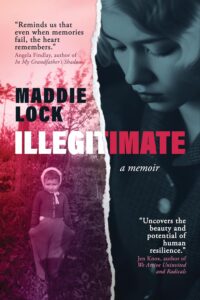 ★★★★★ “Reminds us that even when memories fail, the heart remembers.” Angela Findlay, author of In My Grandfather’s Shadow
Born out of wedlock in post-war Germany, a child enters the world between two people seeking escape and renewal—Susi, a young woman desperate to break free from the drudgery of her life, and a POW yearning to start over. When Susi refuses his offer of marriage, a court order severs him from his daughter forever.
Determined to chase her dreams, Susi joins a dance troupe, leaving her infant daughter, Maddie, in the care of her mother, Katharina—a resilient woman who has already raised six children, three with different fathers. Six years later, Susi returns, now engaged to an American Army officer. Maddie is taken from her grandmother and adopted to be raised in America.
As Maddie grows, she wrestles with her fractured identity and, decades later, finds her way back to her German roots. Just before her 60th birthday, a shocking confession from her Aunt Sieglinde shatters everything she thought she knew: her beloved grandmother once participated in a Nazi eugenics program that encouraged “racially correct” unions to produce children for Hitler’s vision.
That revelation ignites Maddie’s quest to uncover the truth about her own father—a journey that intertwines generations, secrets, and the unyielding need to belong.
ILLEGITIMATE is the true story of two women who had to uncover the identities of their fathers in order to truly understand themselves.
BUY HERE
Category: Contemporary Women Writers, On Writing
Subscribe
If you enjoyed this article, subscribe to receive more just like it.