Let Your Main Character Change You—It’s a Relationship, After All by Lee Upton
 Recently I asked another novelist how she characterizes her relationship with her main character. Without hesitation she said, “It’s a passionate love affair.” That sounds exciting—and fabulous. Our connection with a main character might be volatile, obsessive, teeming with unexpected swerves, even fraught with the possibility of abandonment if the novel fails.
To write a novel requires spending a great deal of time giving shape and weight and momentum to what once had been only a specter, a hint. It usually means staying with this character for at least 60, 000 words, possibly over several years. That’s a longer-lasting relationship than quite a few marriages. We forge a connection, a developing affinity with the main character. It’s less a matter of control than of intimacy, an imaginative bond.
Like many other writers, my characters feel like presences I’m being nudged by, presences who would suffocate if I didn’t listen to them. I have to admit, though, that although conducting a passionate love affair with a main character sounds like a heady experience and maybe I should try it, I don’t think of my relationship with main characters in that way. At least not so far.
For me, writing into being and extending the fictional life of a major character is less like a passionate love affair and more like a slowly-developing friendship. With a friend in the actual non-fictional world, we shouldn’t violently bully them to believe what we believe, and we shouldn’t judge our friends mercilessly. Nor should we pretend to know everything about a friend. Ideally, we respect a friend and allow our relationship to deepen over time. Likewise, in working with a main character I have to realize—repeatedly—that I should offer respect to the character and shouldn’t force the character to believe as I do. In turn, I have to admit I don’t know everything about the character, just as I don’t know everything about a friend. After all, so much work with a character is subliminal and refuses grasping.
My sense of a main character will shift over time, which means I have to backtrack, playing over conversations in the novel, listening intently to what’s already on the page and letting the character have some independence, even encouraging moments for the character to defy my plans. Sometimes writing feels more like a collaboration with the main character than a process that depends on exerting authorial control. There’s always more to be discovered, and not just in a sequel. Close observation over time, generosity of perspective, deepening understanding, even forgiveness—everything we encourage in an ideal friendship—may apply to our work with characters, as does candor, for sympathy and generosity don’t preclude honesty about characters’ motivations.
Yet, while I find it generative and even liberating to think of a main character in terms of friendship, I probably shouldn’t omit mentioning unavoidable differences between actual human friendships and a friendship with a main character. We put our main characters, and hopefully not our friends, in terrible, testing situations, as we introduce and sustain tension and conflict in a plot. Also, we don’t gossip about our friends, or we shouldn’t anyway, but a novel may operate a lot like a long gossip session about a character.
In the course of writing a novel we are on the most intimate terms with this imagined being. A character may be a villain to every other character in the novel. A character may be an avatar of revenge. A character may resist our well-conceived designs. A character may lead us into all sorts of trouble as we attempt to give voice and energy to what we create. We probably ought to allow our characters to roam freely in our imaginations without harnessing them to our continual prejudgments, our premature closure, our easy, calcifying judgments. Yet we bear responsibility for what we make—like Doctor Frankenstein in that cautionary tale about what happens when we abandon our monsters.
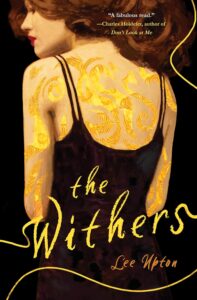
My most recent novel is a work of speculative fiction, The Withers. It concerns a near-future world in which an epidemic, referred to as “the collapse,” leads to widespread organ failure. The novel reflects upon the forced division between the healthy and the unhealthy, the dehumanization of newly vulnerable populations, a corrupt medical establishment, and devious governmental agencies that censor dissent. Riatta, the main character, is marked with glistening scars from a controversial medical transplant. A recipient of a diseased heart, she must rely on the support of the surgeon who saved her life and his wife, a therapist. At one point, Riatta refers to what remains hidden in her culture, even as some indications of normality return. Her reflections remind me of what it was like to animate her as a character:
When I try to imagine what happened during and after the collapse,
I think of a pond in which a rock is thrown. Ripples move outward
nearly to the pond’s rim, and gradually the pond closes up over the
disturbance. The tipping point in the culture, the one everyone predicted, never
arrived—not entirely. Through extraordinary funding for medical research
and new experimental protocols, we were saved from absolute
chaos. That surprised us—everything should have descended into disorder.
Perhaps chaos was just under the surface and took another shape,
burrowing, a form of root damage.
When working with a character we may bring to the surface our own longings and obsessions, putting into form secrets we even hold from ourselves. We dig for “root damage,” and not only the damage the character has survived. The wounds characters endure that make her flinch might make us flinch. A main character may exist only in language, but it doesn’t necessarily feel that may. It’s as if we are making a world together with a character. As the character changes, in a sense, so do we.
Here are three experiments I’ve used to deepen my relationships with my main characters. Maybe they could be useful to you:
I give the character a fantasy, whether I include it in the novel or not. Fantasies should be extreme, to shake free what we imagine a character is afraid of admitting in other contexts. A fantasy is three-dimensional in time, emerging from a past wound that the character suffered; a fantasy indulges in the present by narrating a current desire; and a fantasy projects desire into the future through imagined fulfillment. Writing a character’s fantasy, especially if it’s highly specific almost to the point of comedy, may loosen up our sense of the character and give the character greater dimensionality.
I introduce a sounding board: another character who can be spoken to without self-consciousness. It could be a stranger met in passing, or a seatmate on an airplane, or even a dog that stays still long enough to appear to listen. The listener should be someone who has no control over the character. That sounding board allows a character to speak without being harnessed to expectations. What’s said might strike new sparks for the plot and for extending your understanding of the character’s needs and desires.
A final possibility: Take a vacation with your character to another landscape, figuratively and, if you can swing it, in reality. That is, let your character visit a new environment in your imagination, a landscape that’s physically stunning—and in actual life go away for a while to a place that reveals its beauty, even if it’s only a block away. Imagine how your character would respond to what you’re experiencing. You both deserve a break and could use some breathing space.
—
Lee Upton is the author of the psychological thriller The Withers, which came out in June, and the comic novel Tabitha, Stay Up, forthcoming in September. She is also the author of the mystery novel Wrongful as well as Tabitha, Get Up, named a semi-finalist for the 2026 Thurber Prize for American Humor. Her poetry has been published in five issues of The New Yorker, in many other magazines, and in three editions of Best American Poetry. A collection of her new and selected poems will be out in October 2027 from Saturnalia Books.
TABITHA, STAY UP
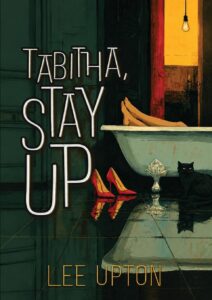 After a shattering disappointment, Tabitha must find new ways to get up-and stay up. In this sequel to Tabitha, Get Up, she faces a determined antagonist and a possible new love, or the return of what appeared to be lost love.
She must save the world’s best bar, contend with diabolical twins and a persistent mystical vision, survive a former cowboy campground, refuse to count her blessings, and at last walk down the aisle again, although not in the way she anticipated.
Tabitha continues her forays into philosophy-how to survive disaster, defy humiliation, and build a life where optimism may be renewed, whenever it needs to be renewed, which is by the minute.
PREORDER HERE
Category: How To and Tips
Subscribe
If you enjoyed this article, subscribe to receive more just like it.