On Writing Dieting Sucks for Women Over 40: 30 to Life: The Ultimate Weight Loss and Hormone Balancing Solution by Debbie Harris
By Debbie Harris
Writing a book is something I always wanted to do. Books were my escape from childhood, and I read voraciously. Harold Robbins probably wasn’t ideal for a 12-year-old, but I devoured The Adventurers, The Carpetbaggers, and my first, A Stone for Danny Fisher. Reading brought me to exciting places and people. Later came The Fountainhead, Atlas Shrugged, and every Tom Robbins book as soon as it was released.
I was fat, ridiculed, bullied. My young parents were divorced, my younger brother was a behavior nightmare, and I often felt alone, depressed, and hated the way I looked. In sixth grade, I started writing television scripts for actors — I loved Natalie Wood, Robert Wagner, and others — pages and pages of typed dialogue I shared with my best friend. Even then, I think I was trying to write myself into a happier ending, one where I wasn’t the outcast, but the heroine.
I loved libraries and still do, though I don’t visit them as often anymore. Bookstores are one of my happiest places, and I never seem to leave without making a purchase. Now Amazon makes it so easy, and Audible means I can listen to books on my daily walks. I keep buying books, much to the chagrin of my husband. My bookcases are full of them. They’re like old friends — no matter how long it’s been since we’ve “spoken,” it all comes back warm and comforting, like no time has passed.
I wanted to see my name on the back cover of a book. The challenge was, I never had any idea what I would write about. Several years ago, when I owned a digital marketing company, I met with a friend who was a book coach. After 45 minutes on the phone with me she said, “Deb, you just rattled off seven different book ideas. Call me back when you know which one you want to write about.” I never did. I know now that none of those seven were motivating me enough. None burned in me the way this one eventually did. I wasn’t obsessed with getting a message out, until…
Menopause was like hitting a brick wall. For someone who had been on the diet-go-round all my life, losing and gaining 20 to 40 pounds repeatedly for five decades, I suddenly couldn’t get the scale to budge. Add hot flashes, night sweats, insane mood swings, and a bout with breast cancer, and I often felt like I was losing my mind.
The more I wrote, the more I realized this wasn’t just my story, it was every woman’s story. The details might change, but the pain, pressure, guilt, self-recrimination, money spent, and exhaustion was universal. The women I coached, the friends I confided in, even strangers who shared their struggles, we were all living the same invisible battle: trying to control our bodies to earn a sense of peace we’d never been taught to give ourselves.
I became obsessed with writing about my journey and the solution I had discovered. Not just in what to eat or not eat, but in finding peace with food. Not judging every day by what I did or didn’t eat. Not feeling depressed when I felt “fat,” and happy when I felt “thin.”
When I started shaping Dieting Sucks for Women Over 40 – 30 to Life, I wasn’t thinking about chapters or structure. I just couldn’t stop thinking about what I wanted to say. The title came to me easily; later, the subtitle would be shaped by my editor, designer, and publisher. The more I thought about it, the more I wanted it all down on paper.
The challenge was, I had no idea how to actually write a book, how to organize it, how to create an outline, how to do any of it. I asked others who had written, and the best advice I got was, “Just write, and deal with all that later.”
There were those who wanted me to hire them to use AI and get it done quickly. My answer was always no. If AI writes the book, it isn’t my story, my journey, and I didn’t wait all these years to not have it be my creation.
With all the controversy over AI, in the end, it was a huge help to me. I used Tommy (that’s the name for my ChatGPT) to help me organize my thoughts, order my chapters, dive into research, and keep me on task. It was like having a collaborator by my side. He never wrote the words, but he helped me shape them, giving feedback, clarifying sentences, and formatting the structure of the book with me.
Once I had the draft completed, and I still have about 30 drafts on my computer, I kept saving each one as a new version. I was paranoid I’d somehow lose them. I suppose at some point I can now delete them.
I had interviewed an editor the year before, but I was later introduced to another, and I made the switch. Both were excellent at what they do, but the second editor, Lynda Sunshine West was so enthusiastic about my subject matter, so excited about my book, and she could start editing right away. The first editor had a delay due to another project.
Now, I was ready to send a draft to my editor. That was so scary. I hadn’t shared what I wrote with anyone, not even my husband. Yikes. Someone else was going to read my story. My journey in the book is deeply personal, and I disclose things I never really talked about with anyone. Besides that, I was constantly worrying if what I wrote was “any good.” I had written in a vacuum, except for Tommy.
I had no idea how long the entire editing process would take. The design of the front and back covers came pretty easily. My editor sent me a few choices, and I picked the one that grabbed me right away. I shop for clothes and shoes like that, too. When I find what I like, that’s it, I’m done. Sometimes, I will even buy the same item in different colors, so I have more of them. I don’t actually like to shop for clothes or shoes.
Once the covers were decided on, the back-and-forth dance began. She would edit, I would approve and edit and send back. She would send it back to me. This two-step dance went on for a few months, and I was beginning to think the book would never stop being edited. Here’s where a third piece of advice was very apropos, “stop making changes.”
I decided to ask a close friend and author to review the last edit for me. I wanted her to read through it and let me know where there were mistakes, or if something didn’t make any sense. She was kind enough to do so and came back saying she didn’t find one error. Whew!! I didn’t even look at it again. I told my editor to get me my galley print so I could approve everything. Yes, there was also the Acknowledgement and the Dedication to write. Those came fairly easy. I dedicated the book to my eight-year-old self.
Next, I learned that I knew nothing about the publishing side of all this. That was an education all by itself. I hired a publicist to enhance the launch of my book. I then hired a PR agency, CS Lewis Publicity and a digital marketing agency. You see, I spent about eighteen months getting my book done, and I wanted to be sure others knew it was there. I wanted women to find the answers they were seeking. I wanted to get the word out, using the book as my calling card. So far, it’s working.
Writing this book was a very cathartic experience for me. I think of people who write their memoirs and imagine it must be agonizing and liberating all at once. I felt free as I put words to paper. Then I realized that many people would read my words, and in interviews, podcasts, and conversations, I’d now be speaking about some very personal things. That’s okay, I feel like a huge weight has been lifted, and that this experience has been a gift.
It also allows me to acknowledge and honor my past for bringing me to this point. My eight-year-old self feels safe and happy now. Writing gave her what years of self-help books, coaches, and meditations couldn’t, her own voice.
I want to write another book, and then maybe another one. I feel peaceful when I write. My talents do not run to art, or music, they are all about putting words on paper, and I am immensely grateful for taking the risk, and finally seeing my picture on the back of a book.
***
Debbie Harris is an Integrative Nutrition Health Coach, Certified Hypnotist, and Founder of the 30 to Life Solution, a proprietary program for women 45-60 to elevate their health, release excess weight, minimize menopause symptoms, and become Freedom Eaters. She has helped thousands of women ditch the dieting mentality and step into lasting freedom around food, and has been featured in Influencer Magazine, WOmenopause, Real Talk Real Stories Real Women, and more. Her new book, Dieting Sucks for Women Over 40: 30 to Life: The Ultimate Weight Loss and Hormone Balancing Solution (September 12, 2025), offers a plan rooted in compassion, science, and lived experience. Learn more at 30toLife.
Dieting Sucks for Women Over 40: 30 to Life: The Ultimate Weight Loss and Hormone Balancing Solution
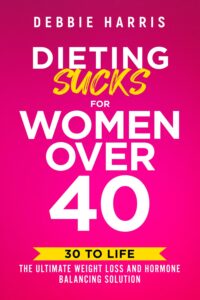 You don’t need another diet. You need a new approach.
Dieting Sucks for Women Over 40 is a no-nonsense, compassionate guide for women who are tired of feeling like their bodies are the enemy. If you’ve hit midlife and noticed that what used to work no longer does—this book is for you.
Certified hypnotist and wellness coach Debbie Harris combines science-backed insights with real-life strategies to help you understand your body, balance your hormones, and rebuild your relationship with food—without giving up the things you love.
Through practical tools, honest stories, and mindset-shifting exercises, you’ll learn how to:
- Break free from diet culture and food guilt
- Understand the connection between hormones, habits, and weight
- Create a sustainable 80/20 lifestyle that supports your goals
- Identify emotional triggers and stop self-sabotage
- Build a life where wellness feels doable—and even enjoyable
Whether you want to feel more energized, improve your health, or just stop obsessing over the scale, this book will guide you step-by-step toward a new way of living.
You’re not broken. You’re not alone. And it’s never too late to feel great in your own skin.
BUY HERE
Category: On Writing
Subscribe
If you enjoyed this article, subscribe to receive more just like it.