The Making of the Musical Memoir, Fly, My Darling By Lisa K. Richter
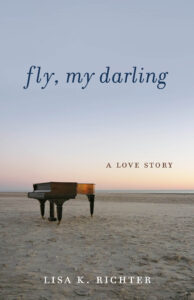 With rhythmic, imaginative prose, Fly, My Darling (April 21, 2026, She Writes Press) explores the resilience of love, the weight of loss, the undeniable pull toward freedom, and the transformation that occurs when a woman finally asks, What do I really want? Based on Lisa Richter’s years together with musician and visionary composer Lynda Roth, past and present weave together in this intimate journey of awakened eroticism, exhilarating joy, nearly unbearable grief, and moments of spiritual renewal. And through it all, there is music. Art must always come first, Lisa is reminded. The connection to the beautiful which transcends. It is how we survive.
The Making of the Musical Memoir, Fly, My Darling By Lisa K. Richter
Lynda Roth entered my life as my jazz piano instructor. An immense musical talent with a renegade past, she was a deeply kind, ferociously intelligent, outspoken woman who enjoyed Scotch and cigarillos and once considered becoming a rabbi. I was a former software engineer, a classically-trained pianist, a beginning writer, a lapsed Catholic living in a gated community with a husband, daughter, and son. And yet there was seemingly no stopping it, the onset of our unexpected and profoundly life-altering love.
When a few years later Lynda was gone from the world, our time together began to feel like a dream. I had an urgent need to make sense of, and hold onto, those luscious, intense, tumultuous years in the middle of my life. They called out again and again, shouting, weeping, and laughing their way into poems and essays. But there was a larger story waiting. Scenes and memory fragments, some on index cards, others on scraps of paper, spread like scattered pearls throughout my office. I studied them for months, searching for the thread that might link them and make them whole.
I began rereading favorite memoirs and narratives: What was it, beyond their captivating prose, that made them work? What was their thread?
In Still Life With Oysters and Lemon, everything flows from a painting Mark Doty encounters in the opening scene of the book. Doty moves through his life (losing a partner to AIDS, the awakening of a new relationship), past to present and back, the painting always somewhere there, sparking the memory, the reflection.
In Rebecca Solnit’s memoir, The Faraway Nearby, she returns again and again to . . . apricots. They’d been on her mother’s tree, and now she has them, a vast pile of them, spread out before her, slowly rotting.
In The Memory Room, Mary Rakow mentioned that until she came across the poem, Todesfuge, by Paul Celan, the book wasn’t finished. She interspersed fragments of Celan’s poem throughout, a thread from which all the memories and poetic reflections could attach themselves, until the entire story became a woven tapestry of recovery.
And then there’s Apeirogon, again not a memoir, though the manner in which McCann portrays the two men (one an Israeli, the other Palestinian) and the conflicts (internal, external, worldly) gives it the feel of one. An intimate story. But it is more than their story. Other pieces of knowledge and historical news are pressed into it. McCann travels freely through time revisiting events from different angles, again and again (the daughters have died, then they are alive, then the men are young, then old, then playing with the daughters ), linking the segments one to another with unique hooks, a thought or word in each showing up in the following, creating an intriguing, intellectual puzzle and grounding us in a flowing time fluster.
I, too, had assembled a collection of seemingly unconnected elements: moments of longing, desire, grief, death, birth, rebirth. Visits to hospitals, family farmhouses, local bars. Childhood reflections, philosophical insights, riffs on mathematical and musical concepts. I tried linking the memories, one to another and then another, a method which came naturally but resulted in nothing more than a complex memory map, a decidedly non-flowing time fluster.
Themes begin to emerge. Flying, certainly: the free motion and freedom of jazz. Improvisation in music and love. The sense (need) to let go, in so many ways.
I scrapped scenes, added others. Distilled thick paragraphs down to a phrase, a heartbeat. It would be important, I knew, to acknowledge the unvoiced: the emotive stillness that holds so much truth.
~
“Is there more?” My lips at her ear.
“Oh darling. There is always more.”
~
I worked out a rough chronological throughline with past events woven in—a story structure with the bones of a beginning (the searching and finding), a middle (the losing), and an end (the finding again). Segments were shuffled. And shuffled. The number of drafts grew. How would I get this right?
Don’t force it, I heard Lynda say as she had so often in the past. Listen.
I began to envision the story as a musical composition in words–poetic phrases surrounded by pulses of silence, allowing the tones, the emotions, to sing. And more: I realized the story’s beginning, middle, and end patterned themselves thematically after classical sonata form—a three-part musical structure in which each movement explores a central theme or motif. Basically, the first section introduces the main theme in a lively allegro tempo; the middle section (the development) challenges that theme, creating a counter melody, slower, pensive, often somber; the third returns to the original idea and quickened pace, somewhat altered, and occasionally in a different key.
A love story in three movements? Yes. Allegro: Lisa meets Lynda; the joyous beginning of flight. Adagio: the diagnosis, loss, a pensive recalculation. Allegro con brio: Paul enters Lisa’s life; a return to love, Lynda spiritually present.
Would readers get it? Most, likely not. But that was okay. The memoir had found its shape. The thread I’d searched for, of course, was music. It had been there all along.
Buy Fly, My Darling: A Love Story HERE
—
Lisa K. Richter is an American writer and poet. She is the author of Fly, My Darling: a love story, an intimate lyrical memoir, and Searching for the Talisman, an online essay series inspired by a classic 1929 Italian cookbook. Her poems, essays, and stories have been featured in journals, anthologies, and literary blogs. A poetry alumna of the Community of Writers, she holds an MFA in fiction from Antioch University, earned her BA in mathematics from the University of Virginia, and in 2002 founded a company teaching computer coding to young people. She grew up on the East Coast, lived years in Europe where her daughter and son were born, and now resides in southern California.
Category: On Writing
Subscribe
If you enjoyed this article, subscribe to receive more just like it.