The Story Behind the Story by Liz Alterman
You’ll Be Sorry
Revenge is a dish best served now.
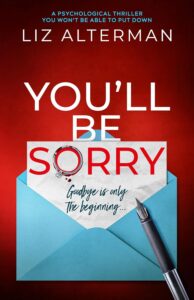 On the eve of her fortieth birthday, Amelia Montgomery flips through a magazine and freezes at the sight of a familiar face—Ethan Blackmore, the man who shattered her heart more than a decade ago.
What should’ve been her happily-ever-after took a devastating turn that spiraled into the darkest period of Amelia’s life. Blindsided and betrayed, she spent years reinventing herself, building a thriving business, and vowing never to look back.
Until now.
Seeing him again reminds Amelia of the shame and humiliation she endured at the hands of her ex and his family. And Ethan? He’s clearly moved on—new wife, new career, new life—without a thought for the wreckage he left behind.
But Amelia is a different woman now—strong, successful, and resourceful. And she knows exactly what she wants for her birthday: Revenge.
—————————————————————————————————
If you attend author talks, one of the most common questions you’ll hear is “Where did the idea for this novel come from?”
Answers vary. Some writers say they were inspired by a news story. Others explain they overheard a conversation that planted a seed. Some reveal they had a dream that brought a character or plot to life in their mind.
Regardless of how an author answers that question, as readers, we often suspect that something contained in those pages is pulled from the writer’s real life.
In my first suspense novel, The Perfect Neighborhood, I set the story in a town called Oak Hill, a fictional suburb similar to the one where I live, which also resembles the town where I was raised as well as two other New Jersey communities where I previously worked.
Each time someone from one of these areas reads the book, they’re certain it’s their town and I assure them it’s a composite of all these places.
When I wrote my novel A Different Type of Poison, which features a bestselling author whose desire to stay relevant leads her to make a bad decision, I channeled plenty of my real life frustrations with the publishing industry into the story.
At a reading, my main character, Molly Archer, is signing books and taking questions, when an attendee says, “These characters feel so real to me. Did you base them on people you know?”
Molly, aware that this would come up, responds with a practiced yet coy, “Oh goodness, I think we all know people like these characters, don’t we?”
While Molly won’t answer that question directly, I will.
For my latest suspense novel, You’ll Be Sorry, I did base a character on a person from my past.
In my twenties, I dated someone with an unpleasant sibling—a sister, who, after a few drinks, would pull me aside and say unkind things to me. The first time it happened, I thought I’d misheard or misunderstood her. When she did it again, I was still caught off-guard.
As my face flamed and my stomach dropped, I was angry at her but also annoyed with myself for not asking, “Why are you behaving like this? What have I ever done to you?” or serving up a witty or biting retort that would stop her from doing it again.
I felt a bit like George Constanza in that Seinfeld episode in which his co-worker embarrasses him by saying, “Hey, George, the ocean called and they’re running out of shrimp.” George, gorging himself with crustaceans, has no comeback, and for days it haunts him until he’s able to recreate the scenario, and still, he’s bested by this caustic colleague.
Like George, I never got the upper hand.
When I mentioned this woman’s rudeness to her brother—the man I was dating—he made excuses: she was tired, she was lonely, she drank too much, worked too hard etc.
While all or some of that may have been true, it was no excuse for the way she treated me.
I wish I could tell you I got real life closure and learned why she acted that way. But I don’t know and, thankfully, that family is firmly in my rearview. That said, I’ve always thought about what an interesting and diabolical character she would make.
And what if, more than a decade later, that character ran into the woman she hurt? But now that woman is wiser, more resourceful, and ready to even the score.
Needless to say, I had a blast imagining a meddling sister who may or may not get what she deserves at the hands of the woman whose life she tried to destroy.
Unlike my main character, Amelia Montgomery, I’ve honored my promise to keep my search history free of this family.
For me, writing and telling a story that entertains is always cathartic and sometimes… the best revenge.
—
Liz Alterman is the author of several suspense novels, including her latest, You’ll Be Sorry. Visit her website or subscribe to her Substack where she shares the ups and downs of the writing life (and cat photos).
Category: On Writing
Subscribe
If you enjoyed this article, subscribe to receive more just like it.