Writing was Never that Hard for me Until …
I had several concussions in the span of 6 weeks. Most people apparently stop after the first one. Perhaps I unconsciously wanted to try to set a record, so I had five in 6 weeks.
While not relevant to this story, everyone seems to want to know what happened, so I will share.
The first one involved moving a heavy oak table into a minivan late at night in the dark, and it collided with the side of my head.
The second involved standing up under a cabinet we had recently hung in the garage at chest level, hitting the top of my head.
The third and fourth (demonstrating how the first two concussions impaired my judgment and risk-assessment ability) involved trying water skiing for the first time. Who knew that falling on water at high speed feels like hitting concrete, even with a helmet?
The fifth happened after I shared my symptoms of headaches, loss of concentration, inability to read and work, etc. with a colleague who had experienced concussions. She recommended that I go home and rest (not my forte), so I excitedly decided to hang a hammock I had owned for years but never used. Apparently, tying good knots is more challenging after multiple concussions, and the hammock fell when I got in. I finally went to the doctor – who was shocked it took me so long to see her – instead of powering through.
Until that time, I had been writing almost daily and sending my drafts to a friend. We would meet a few days later for lunch, and she would provide comments and suggestions. This provided accountability and feedback.
But, I discovered that my head injuries had made it impossible for me to control my left-to-right eye movement, which explained why reading and writing had become so difficult. Maybe if I tried writing in traditional Japanese (which is written vertically) it would have been easier… but I didn’t have the energy for that.
My friend told me that I might just have to give up on finishing the book, even though I had written 100,000 words.
Two years of vision therapy, which was initially delayed by the global pandemic, retraining my eyes and brain helped me be able to read and write (and have energy for thinking) again. And slowly, after regaining functioning in many areas of my life, I started to think about revisiting the book. Since computer screens and sustained focus often gave me headaches, I knew I would have to adjust my way of working.
Interestingly, although my vision and organizational skills were seriously impaired by the concussions, my ability to talk was not significantly affected.
I wanted to reorganize the book, but knew I needed help. So, I hired a developmental editor (Pia Kohler, whom I cannot recommend highly enough). I also knew that I couldn’t sit in front of my computer and type for very long.
I used a gift (perhaps the only gift?) of the COVID-19 pandemic. Zoom.
Zoom had become pervasive at work. I had discovered the automatic transcription function, which although it had limitations, could turn an hour of conversation or lecture into a document of text to be edited.
I decided to ‘teach’ the new organization of my book (on aging) to a virtual class of lifelong learners (including my parents who were in their late 70s at the time). I delivered a series of 10 hours of lectures (with discussion) on the biocultural aspects of aging, and students asked interesting questions and gave great feedback. My editor heroically took my new organizational outline and transcripts and merged them with excerpts of my previous 100,000-word manuscript.
And then I began to painstakingly revise, sending her weekly versions of whatever I had edited. It took another few years to complete the manuscript, constrained by the demands of parenting two teenagers, teaching, conducting research, doing professional service, and other health issues.
Definitely the tortoise, not the hare, approach to writing a book.
While I would never wish concussions on anyone, and still regret and sometimes even resent the disability I have experienced because of the concussions, they forced me to get creative about finishing the book, and to ask for help not only from my editor but also my parents and their friends, and many readers. And I do believe that the final product is much better for their input and feedback.
If I had not experienced concussions, I likely would have believed I had to write it by myself, and never ‘taught’ the book or hired an editor.
I learned the importance of asking for help, that talking can be ‘writing’ (especially with the help of Zoom’s automatic transcription function), and that daily writing (even if only for 15-30 minutes) can eventually help you cross the finish line. I also realized that working with an editor and readers can make the often solitary or isolating experience of writing a book into a more social activity, which may be important for extroverts like me. And I learned to be more accepting of whatever tricks (Zoom), tools (automatic transcription), or resources (primarily social) I needed to meet my goal of finishing my book.
My book is about aging and menopause in Japan. The term kōnenki, often translated as menopause but more akin to the climacteric involves a kawari me – what Japanese consider a turning point in the life course. My concussions were a significant turning point in my personal and professional life. I thought I might never work again. It is true that I would never work like I worked before. But I found different ways to work, more collaborative, more dependent on the help of others, and ultimately more enjoyable and satisfying as a process.
I hope that others who are struggling to overcome disability or life’s challenges in order to write will find inspiration in this story.
—
Melissa K Melby is an author, medical anthropologist and Professor of Anthropology at the University of Delaware (with degrees in Chemistry, Environment & Development, and Anthropology), and a coach. Her book, Reframing Aging: Insights from Biology and Culture of Midlife Japanese, is published by Routledge (http://bit.ly/4mXL43S).
Purchase from the publisher or Amazon
Reframing Aging: Insights from Biology and Culture of Midlife Japanese
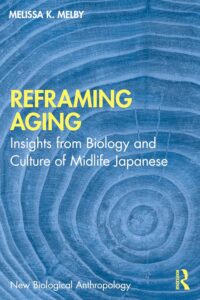 Reframing Aging introduces a framework to guide the reader through questions of how and why we age, and experience menopause, in Japan, the United States, and beyond. Too often the focus is on how biology works rather than why. But many want to know: Why do some people but not others have symptoms at certain times in the life course? No single level tells the whole story: insights from complementary levels provide important pieces of the puzzle, whether that puzzle is aging or menopause, or other health phenomena like depression or diabetes. Biology is not destiny, and many biocultural factors influence the experience of aging and menopause.
With increasing media attention about empowering menopausal women (mostly promoting access to hormones, with unclear risk/benefit communication) consisting mostly of over-simplifying narratives attributing almost everything to ‘loss of estrogen’ the need for more nuanced and honest communication about the biological and cultural variation in the experience of menopause and aging has never been greater.
Women deserve to have truly informed consent about what to expect and options. This book explores how many symptoms women experience at this time may not be caused by hormones but by processes of aging, psychosocial stressors and expectations, and societal and environmental factors. In the West, there is a tendency to reduce symptoms to a single cause, and then try to fix it with a drug. This may work for some conditions but often has unintended consequences.
Drawing on years of fieldwork and lab work in Japan, and over a decade of living and working in Japan at several universities and the National Institute of Health and Nutrition, with follow-up interviews spanning over 20 years, Melby challenges what are often considered “normal” experiences of aging and menopause and inspires readers to expand their perspectives, to ask questions, and seek more nuanced explanations that reflect and shape the diversity of women’s experiences.
Category: On Writing
Subscribe
If you enjoyed this article, subscribe to receive more just like it.