On Writing FRIENDSHIP SKILLS FOR NEURODIVERGENT ADULTS by Caroline Maguire
When I sat down to write Friendship Skills for Neurodivergent Adults, I was not starting from a blank page. I was starting from decades of listening, brainstorming, and searching. Searching for answers that my clients share routinely after a tough conversation with a friend, or a confusing conversation with a coworker or a shameful moment with a loved one.
Everyone asked the same question, “Why is making friends so hard for me?” That was the real start of this book. In my head I would answer their questions sometimes with witty and practical solutions; other times, I would noodle over something that felt particularly sensitive where there was no “great” answer. But in all of this listening and seeking, what I found were layers of patterns.
Many of the challenges people described did not stem from a lack of effort or from trying. They were about missing information. The heart of which was that no one had ever explicitly taught them how friendship works. The expectation was that my clients (and really everyone around me) was expected to pick up this skill intuitively, through observation, nuance, and unspoken rules. For neurodivergent individuals, implicit learning of this nature does not often happen in the same way it does for a more neurotypical brain… so I set out to create a process to teach my clients how it was done.
My job, as I saw it, was to transform something invisible and make it visible. I needed to break down social dynamics into concrete, teachable parts without robbing them of what makes the experience of making a friend special. If my advice was too robotic or formulaic, would it lose the spontaneity or authenticity that lives between two really great friends? How do you explain something like “reading the room” in a way that feels practical instead of abstract? And how could I approach meaningful topics without telling people “you need to change?”
I spent a long time organizing the material before I wrote full chapters. I mapped out what I call the “hidden curriculum” of friendship. These are the unwritten rules that many people absorb naturally but are rarely explained. Things like timing, reciprocity, emotional pacing, and repair after a misstep.
Once I had that framework, the structure of the book became clearer. It needed to move in a progression that matched how people actually build connections. That started to look a little like this:
- First, understand how friendship works.
- Then, learn how to find your people.
- And finally, understand how connection creates momentum in your life.
That structure reflected the emotional journey I see in my clients. You cannot sustain connection if you do not understand the mechanics. You cannot find your people if you do not know what to look for. And you cannot experience the benefits of connection if you are stuck in cycles of confusion or avoidance.
Another important part of my process was seeking out the voices in the neurodivergent community to talk to. I started a wish-list of people to interview which led to powerful, practical conversations about many theoretical facets of the book. These discussions became the backbone of my storytelling as I gathered momentum researching concepts like code-switching, bullying and masking. I wanted everything grounded in real-life so I decided to include many voices in the book alongside my own.
The stories and insights were so powerful, and much more in-depth than I could put in the book, that I started a podcast to capture them all. That said, I was careful about how I presented their experiences in the book because the goal was not to catalog mistakes but rather offer insights that crossed many more lives than just my own.
There were also parts of the process that were more personal than I expected. Writing about friendship means writing about vulnerability. It means acknowledging how much we all want to belong, even if we do not always say it directly. I had to be mindful of tone. If the book felt too clinical, it would miss the emotional reality. If it felt too abstract, it would not be useful.
So I kept returning to the same question, “Will someone feel understood when they read this?” If the answer was no, I rewrote it.
Another layer of the process involved language. The way we talk about social challenges matters. Many of the people I work with have internalized years of negative feedback. They have been told they are awkward, self-centered, or difficult. I wanted to shift that narrative without dismissing the real challenges they face.
That meant being precise. Instead of labeling behavior, I focused on describing it. Instead of saying someone is “bad at conversation,” I might describe how they miss a transition cue or have difficulty tracking multiple threads at once. That shift may seem small, but it changes how people understand themselves. And, it moves them from judgment to curiosity which is so important when someone is trying a new skill and they’re uncertain about themselves.
In the end, this book is not just about friendship. It is about making the invisible visible. It is about giving people a framework they were never given and a language they can use to understand their experiences. Friendship is such an important piece of the happiness puzzle and I’m so thankful to have been able to put all of my thoughts together and share it in my book with you.
—
Caroline Maguire is a graduate of Trinity College and holds a Masters in Education and early childhood development from Lesley University. She is also a graduate of the ADD Coach Academy (ADDCA) and the founder and director of ADDCA’s Fundamentals of ADHD Coaching for Families, the only family-focused coach training program accredited by the International Coach Federation (ICF). A featured TEDx speaker and a keynote presenter at the International Conference on ADHD, her work has been covered in U.S. News & World Report, MindBodyGreen, Salon, Huffington Post, TODAY Parenting, ADDitude, Attention Magazine, and WebMD. She lives outside of Boston. Learn more at her website, on Instagram, and LinkedIn.
Friendship Skills for Neurodivergent Adults: A Guide for the Anxious, Uniquely Wired, and Easily Distracted
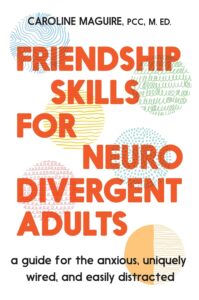 From a social emotional learning expert: a book providing simple, science-based, practical advice including scripts, tips and strategies to help Neurodivergent adults who have ADHD, autism or anxiety find the belonging and support of lifelong friendships they seek.
Friendship can be hard for many Neurodivergent adults. There is an assumption that good, worthwhile friendships “should” come easy. However, for Neurodivergent adults, there are brain-based reasons why friendship can feel less intuitive. From differences in the parts of the brain that are vital to managing the logistics of a fulfilling social life to difficulty with self-regulation, the way neurodiverse individuals experience social bonding and connection can feel unintuitive.
Friendship Skills For Neurodivergent Adults is a guide to navigate these differences, broken into three parts:
1. How friendship works
2. How to find your people
3. How connecting will get you in motion
With the guidance of Friendship Skills For Neurodivergent Adults, readers will feel less alone, and have the tools to understand the unique way neurodiverse individuals can approach friendship.
BUY HERE
Category: Contemporary Women Writers, On Writing
Subscribe
If you enjoyed this article, subscribe to receive more just like it.